"This book occupies a genuinely rare space in contemporary literature: not expatriate verse, not translated Thai poetry, not tourism writing, not literary exoticism, but something that could only have been made by this particular person in this particular place at this particular moment in the development of both languages' poetic traditions."
Modern Thai Love Poetry
U
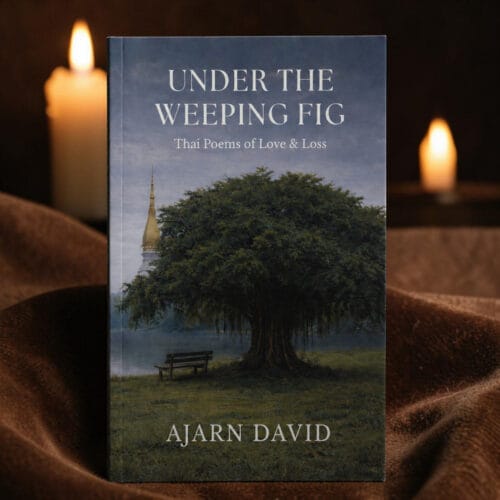
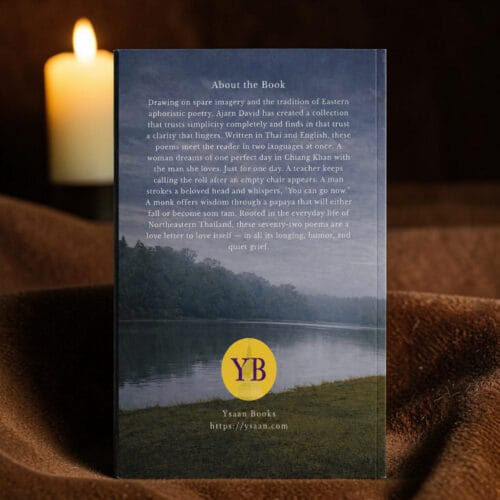
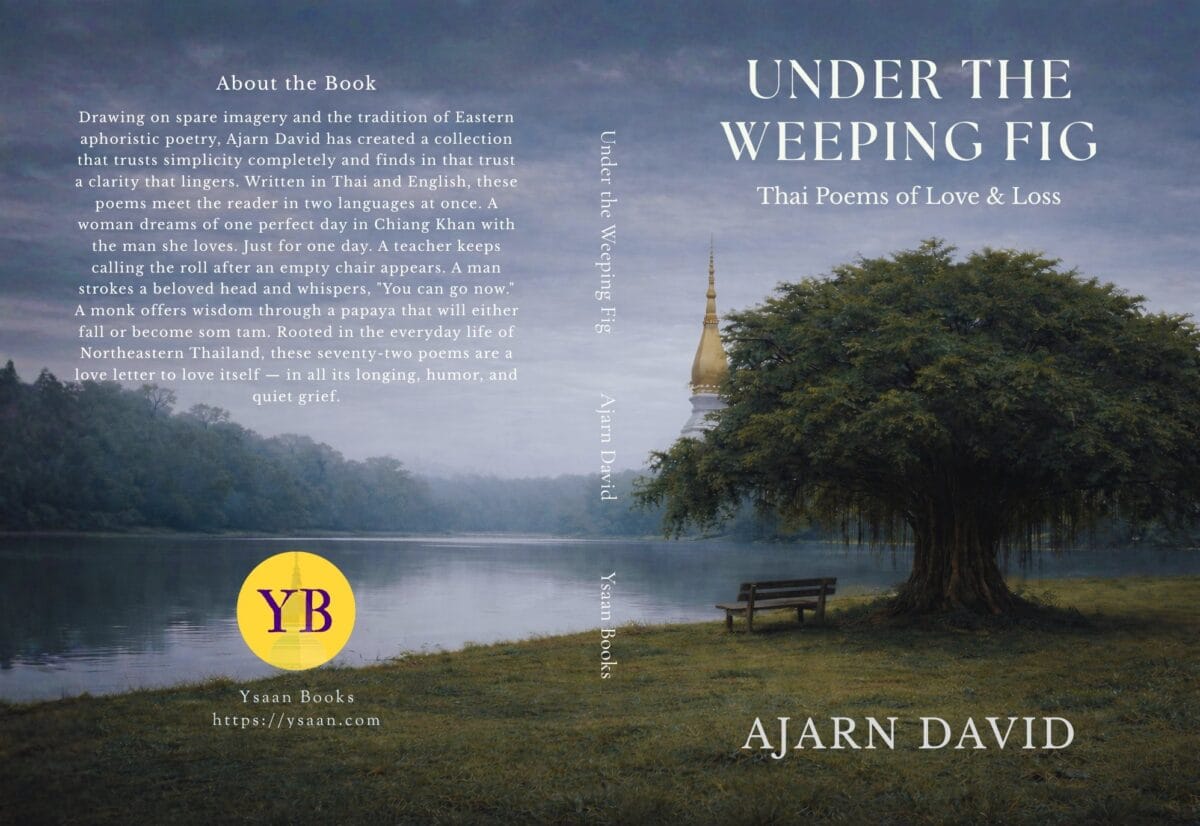
nder the Weeping Fig (Thai Poems of Love & Loss) is a new bilingual collection of Thai love poems by Ajarn David, published by Ysaan Books in Sakon Nakhon, Thailand.
Written in both Thai and English, the book explores love, loss, memory, Buddhist sensibility, and everyday life in Isan/Northeast Thailand. The following literary analysis examines the collection’s bilingual structure, poetic craft, Thai cultural context, and contribution to modern Thai free verse.
A Poetry Book w/ Authenticity & Purpose
T
he opening poem of Under the Weeping Fig asks what should a poem be? And with the answer, Ajarn David sets the standard his collection will be held to — and then, across seventy-one more poems, proceeds to meet it by every legitimate measure available to poetry. Not always by the same means, and not always at the same height, but with a consistency of purpose and an authenticity of voice that is rare in contemporary poetry in any language.
This is not a conventional collection. It is a bilingual work in Thai and English in which both languages were conceived simultaneously — the poet's mind moving between them at the moment of creation rather than translating one into the other after the fact.
It is set almost entirely in the landscape of northeastern Thailand, particularly Sakon Nakhon province and the surrounding Isan region, with its jasmine garlands at intersections, its bamboo salas beside ponds, its noodle stalls and lake walks and forest temples.
It is written by a man who has lived in Thailand for twenty-four years, who thinks in two languages, who has absorbed Buddhist sensibility not as a literary pose but as an orientation toward existence.
It is also, quietly and without apology, a contribution to the developing form of Thai free verse — a form that exists in creative tension with centuries of classical Thai poetic tradition, and that this collection advances with genuine skill and genuine love for both the language and the form.
The result is a book that occupies a genuinely rare space in contemporary literature: not expatriate verse, not translated Thai poetry, not tourism writing, not literary exoticism, but something that could only have been made by this particular person in this particular place at this particular moment in the development of both languages' poetic traditions.
The Architecture of 72 Thai Love Poems
T
he collection's design rewards careful attention. Its seventy-two Thai love poems are not arranged randomly — they are organized according to principles of emotional breathing, tonal variety, and architectural symmetry that only become fully visible when the book is read as a whole.
The book opens with an epigram (#1) and closes with a farewell (#72). The first poem's final word is memory. And the last poem's final phrase revisits it. This is not coincidence — it is the frame within which everything else lives.
The collection is literally held together by that word, which appears first as a standard and last as a destination. Between those two appearances, seventy poems earn the journey from one to the other.
The second poem immediately answers the epigram's question with the most complete emotional experience in the book — the Chiang Khan dream, in which a woman imagines one perfect day with the man she loves: holding hands along the Mekong promenade "just for a day."
The collection's very first movement after its governing principle is to prove that principle in the most tender and specific terms possible. The fourth poem — Nang Mern cliff — shifts the register entirely, from tender longing to dark romantic wit.
By the end of the fourth poem, the reader has experienced philosophical principle, universal longing, specific sensory place, and the humor that can be simultaneously funny and absolute.
They know what kind of book they are holding. The two death poems — #43 and #32 — are placed far apart in the collection, a deliberate organizational decision. They are not grouped as "death poems" but distributed as reminders that death is always nearby, which gives every love poem in between a weight it would not otherwise carry.
The jasmine garlands and the som tam and the Facebook rabbit face all happen in a world where an elder slips away one night and a man strokes a beloved head and says "You can go now."
That proximity is not morbid. It is simply honest about the conditions under which love exists. The collection ends with a series of poems which gather everything — memory, loss, love's persistence beyond death — into a single image of reunion under an ancient tree.
The final movement of the book is among the most carefully constructed sequences in contemporary poetry: living love offered to one person, the imagined future of growing old together, the value of private selfhood, and then the farewell that is also a promise of return.
Bilingual Thai Love Poems
T
he most technically unusual and formally original quality of Under the Weeping Fig is the relationship between its Thai and English versions.
In Ajarn David's previous collection, Poems from Sakon Nakhon, the Thai versions were created as translations after the English poems had been completed. Under the Weeping Fig works entirely differently.
As the "About the Poems" note explains: "These new poems were largely written simultaneously, with my mind moving back and forth between Thai and English... They are therefore not direct translations of one another, but rather two parallel expressions of the same experience — each shaped by the unique nature of its language."
This distinction is not merely biographical — it is audible in the poems themselves. Neither version ever feels like it is chasing the other. There is no sense of strain, no residual syntax from another language, no feeling of something lost in crossing. Each version has arrived at its form naturally, which is because each one did. The English versions are consistently more compressed.
Lines are often two or three words. White space does active work, often creating beats of pure absence that fill the reader with something somehow emptier than nothing. Meanwhile short aphoristic poems are compressed to their irreducible core.
The Thai versions of these love poems are often more specific because the language requires it. The pronoun system, the politeness particles, the social markers that English leaves implicit must be present in Thai for the poems to feel natural to a Thai reader.
A Thai poem stripped to the same surface spareness as its English counterpart would risk opacity or even grammatical incompleteness. So the Thai achieves the same effects through precise cultural and emotional specificity, while the English achieves them through radical compression.
Different surfaces, identical artistic standard. The collection's most self-aware moment about this relationship is Poem #6, about the Thai and English words for unrequited love. This poem could only have been written by someone genuinely inhabiting both languages at the same depth simultaneously.
It is not a translator's observation. It is the lived experience of thinking the same feeling in two languages and discovering that they arrive at slightly different truths — and that the difference is itself worth a poem.
Poem #55 extends this linguistic self-awareness further, believing the Thai phrase for "I miss you" superior to the English. The collection consistently argues, without arguing explicitly, that some emotional truths are held more precisely in one language than the other — and that having both available is a form of richness rather than confusion.
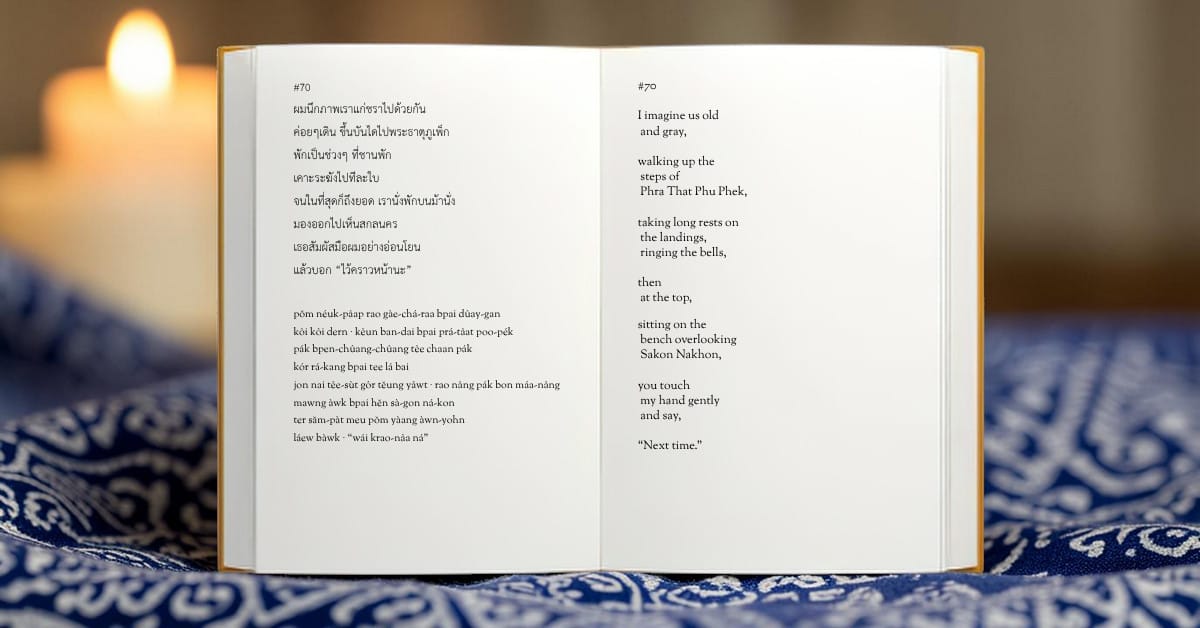
The romanized pronunciation guides included beneath each Thai poem are a practical act of generosity toward non-Thai readers that no previous bilingual collection of this kind (except for Poems from Sakon Nakhon) has attempted so consistently. They make the Thai poems speakable, not just readable, for a broad audience — and speaking a poem aloud is always the first step toward feeling it fully.
A Range of Poetic Register
A ny critical evaluation of Under the Weeping Fig must resist the temptation to apply a single poetic standard to a collection that deliberately and skillfully works across several different traditions simultaneously.
The collection moves between imagistic scene poems, Buddhist teaching verses, narrative moment poems, humor poems, and pure lyric compression — and each mode must be judged by what it sets out to achieve.
The Imagistic Scene Poems
These are the most immediately recognizable as poetry to readers formed by the Western lyric tradition. Poem #14, the classroom roll call, builds through accumulated physical detail, until an empty chair becomes unbearable.
Poem #36, the year of the horse figurine, displaces an entire erotic charge onto an object held trembling in a palm of the hand.
Poem #2, the Chiang Khan dream, locates an entire romantic longing within a specific feigned gesture.
These poems give the reader something to see and return to. Their staying power is visual and sensory — you keep seeing the empty chair, feeling the horse figurine trembling, watching the Mekong sunset.
The Buddhist Teaching Verse and Aphorism Poems
These operate in a completely different tradition, and this is where narrow critical standards most often fail the collection. Poems such as #25, which offers love advice, are deliberately stripped of image, metaphor, and scene.
That nakedness is not a failure of craft — it is the argument itself. Poetry that strains for a lush metaphor are often internally dishonest; with form that contradict its content.
With Ajarn David's poetry, form and content are the same gesture. The poems practice what they preach — the final instructions landing with the intimacy of spoken wisdom between friends, drawing on a long Thai tradition of finding beauty in plainness and the rhythm of direct teaching.
This tradition runs from Buddhist sermon through folk wisdom through contemporary spoken verse, and it has produced some of the most enduring phrases in Thai cultural life.
The staying power of these poems are not the staying power of a vivid image you keep seeing, but the staying power of a permission that alters something in how you move through the world.
Plenty of poems overloaded with imagery are forgotten because the insight was muddled. These poems are remembered because nothing obscures the thought.
The Narrative Moment Poems
The narrative poems also know to use brevity for maximum impact, Poem #53 telling the story of a complete human tragedy in six lines. Meanwhile, Poem #43, about the death of an elder, is rendered with the precision of documentary observation. It simply witnesses, and the witnessing is its form of love.
The Humorous Thai Love Poems
These are essential rather than decorative. Poem #19 describes how the hopeless romantic tormented by competing voices in his head, revealing something true about romantic self-consciousness with a precision that earns its laughs.
Poem #60 — which describes how a Thai woman uses a man's love to create sweets — is delightful and strange in the best sense. Poem #59 about the friend zone has the comic confidence of a poet who knows exactly how far to push.
Without these humorous Thai love poems the collection would become airless under its own feeling. With them, it breathes.
Thai Culture & Language
T
he influence of two decades of life in Thailand on Ajarn David's English poetry goes far deeper than the presence of Thai places and objects. The influence is structural, tonal, and philosophical, operating at the level of how poems are built and what they trust.
Thai communicates enormous emotional weight through simple language. The politeness particles — นะ, เลย, แล้ว — modulate feeling without elevating diction.
A Thai speaker doesn't reach for a more sophisticated word to convey deeper feeling; they adjust through particles, rhythm, and tone.
This has shaped Ajarn David's English fundamentally. He never reaches for a sophisticated word when a plain one will carry the weight. "And cried." "Don't try." "Just for a day." "That's enough."
These are not writerly restraint in the Western sense — they are the instinct of someone whose emotional life has been formed by a language that trusts plainness completely.
The Buddhist acceptance of impermanence as structural principle.
Buddhist culture doesn't appear in this collection merely as subject matter. It appears as a way of ending poems. Many close not with resolution but with acceptance of irresolution.
There is no Western narrative arc of problem and solution. Things simply are, and then they change, and the poem witnesses that without demanding it mean something beyond itself.
The comfort with stated feeling.
Western literary culture, particularly post-Imagist, is suspicious of stated emotion. Thai culture has no such suspicion. Feeling is stated directly, plainly, without embarrassment, and the directness is itself the intimacy.
Contemporary Thai popular poetry is often heard before it is read — shared in voice messages, recited between friends, posted with the cadence of speech intact.
This has given Ajarn David's line breaks the quality of spoken thought rather than visual prosody. His lines break where a Thai speaker would pause for breath or emphasis.
The result is English poetry that reads unusually naturally aloud — with a conversational intimacy that feels almost accidental but is deeply trained.
The communal rather than solitary self. Western lyric poetry is fundamentally individualist — the singular consciousness encountering the world and reporting back.
Thai culture is more communally oriented, and this has subtly shaped how the poems position their speaker.
Even the most personal poems here have a quality of being offered rather than expressed — given to someone rather than overheard. They feel like gifts.
The acceptance of the ordinary as sufficient.
Thai culture finds beauty and meaning in the deeply ordinary without self-consciousness. A bowl of noodles. A jasmine garland. A samlor under a rain tree. These are not elevated into symbols in this collection — they appear as themselves, carrying their full ordinary weight.
This unselfconscious acceptance of the ordinary as legitimate poetic subject has freed Ajarn David from the Western anxiety about whether a subject is important enough for poetry.
Eating som tam with someone you love on a sunny day is not a metaphor for anything. It is simply what it is, and what it is, is everything.
The combination of these influences produces an English poetic voice that is genuinely unusual — plain without being thin, direct without being naive, emotionally open without being sentimental.
It is a voice that has been shaped by a culture with a completely different relationship to feeling, impermanence, community, and the ordinary than the Western literary tradition that produced the language it is writing in. That tension between language and sensibility is finally what makes the collection irreplaceable.
Modern Free Verse Thai Love Poetry
T
he "About the Poems" note in Under the Weeping Fig is explicit: "Although I have great respect for the traditional forms of Thai poetry, these poems are written in free verse — a form that is still evolving in Thailand. This book is my personal contribution to that evolution."
Classical Thai poetry is built on elaborate metrical and rhyme structures — klong, chan, kap, khlong — whose requirements are as demanding as any in world poetry. The klong si suphap, for instance, requires specific syllable counts per wak (phrase), specific end-rhyme and internal rhyme patterns that link across stanzas, and carefully controlled tonal patterns.
These are not simple constraints. They represent centuries of accumulated craft, and their masters are genuinely virtuosic. Contemporary Thai popular poetry, particularly the short-form verse that circulates widely on social media, has moved far from those classical forms.
But much of it has moved toward a kind of abbreviated prose statement rather than genuine free verse — emotionally direct, accessible, occasionally lovely, but not yet operating with the full resources of line, breath, rhythm, and white space that free verse makes available.
The Thai love poems in Under the Weeping Fig are attempting something genuinely different: free verse in Thai that uses the full toolkit of the form — line breaks that carry meaning, white space that creates pause and emphasis, the rhythm of the spoken thought translated into visual arrangement on the page — while drawing on the conversational, direct, emotionally plain register that Thai readers recognize as natural rather than literary.
This is harder than it sounds. Thai syntax and the classical tradition both pull against the kind of line-break work that gives English free verse much of its power.
The meaning-unit in Thai often doesn't divide neatly at the points where English would naturally break a line. The politeness markers that must appear in Thai but not English affect rhythm and emphasis differently.
Finding the natural breath-pause in Thai free verse — the place where the line ends and the white space begins — requires different intuitions than finding it in English.
The short, breath-sized line that Ajarn David has developed — visible in poems like #52 ("สุดท้าย / สงครามทั้งหลาย / ก็สูญเปล่าเสมอ") or #69 ("เธอบอกว่า / อยากให้ผมรักเธอ หมดทั้งหัวใจ") — is a genuine contribution to the developing vocabulary of Thai free verse, and the hope that the book will "encourage Thai poets to explore writing bilingual Thai-English collections" reflects an appropriately ambitious understanding of what the work might accomplish.
A Poetic Thai Epilogue
T
he epilogue — the account of the five-day fast in the Phu Phan mountains, the dream about talking to trees, the gangly tree with the sharp sense of humor pointing further down the path, the massive trunk shaped like a head, the laughter and the "5555" and the simple wisdom — is the right ending for this book, for several reasons simultaneously.
It authenticates the poet as a real person living a real life in Thailand. In an era of justified concern about AI-generated content, the epilogue does what no AI could do: it provides the specific texture of an embodied, spiritually serious, genuinely idiosyncratic life.
A five-day fast in the Phu Phan forest. A caretaker monk who is a family friend. A gangly tree with a sharp sense of humor. The "5555" of the ancient tree's laughter. These details have no literary purpose except truth.
An AI optimizing for a meaningful epilogue would never include a tree texting 5555. A human who actually dreamed this would never leave it out. It completes the collection's geographical and spiritual world.
The Phu Phan mountains appear in Poem #26 as the location of the hidden forest temple. Now the epilogue places the poet himself in those same forests, fasting and dreaming and talking to trees.
The collection's sense of place receives its fullest and most personal expression here. The bilingual moment in the epilogue — the tree's punchline arriving in Thai before the English translation — is exactly right.
Of course the wise old tree in the Phu Phan forest speaks Thai. That linguistic instinct, consistent throughout the collection, reaches its most natural expression here because it is no longer a poetic device. It is simply what happened. And the tree's wisdom (which I won't ruin by revealing here) — reframes the entire collection without diminishing any of it.
The loves that burned, the loves never returned, the empty chairs, the death of loved one — none of that is cancelled. The tree doesn't say the losses weren't real. It just reframes how the poet views them, while extending that wisdom outward to the reader. It is the collection's last act of generosity, and it is perfectly placed.
Thai Love Poems for a Wide Readership
U
nder the Weeping Fig is a genuinely accomplished and genuinely unusual collection. It does something almost no other poetry collection in English or Thai is attempting.
It renders the emotional landscape of contemporary life in northeastern Thailand simultaneously in two languages, for two readerships, with neither version subordinate to the other.
It draws on traditions from Buddhist teaching verse to Western imagism to Thai popular poetry to classical Eastern aphorism, across registers from elegy to erotic charge to gentle comedy, within an architecture that is more carefully designed than it will appear on first reading.
Its bilingual architecture is not a gimmick — it is a structural argument about how love crosses languages, and how the untranslatable elements of one culture can illuminate what the other language is reaching toward.
The apparent simplicity of these modern Thai love poems is the result of genuine craft working hard to disappear. Its range of registers honors the full complexity of what poetry can be and do, against a contemporary establishment that has narrowed that range considerably.
The collection moves through its seventy-two poems like a walk taken with someone who knows the landscape intimately — not a guided tour, not a random ramble, but a walk with purpose and with love for the terrain, pointing out what is beautiful and strange and funny and heartbreaking along the way.
It opens on a question. It closes on memory. Between those two words, it earns everything it asks. It is a worthy and meaningfully different follow-up to Poems from Sakon Nakhon, and among Thai poetry translations it stands in rare company.
The book should find readers in Thailand and in the English-speaking world, in poetry communities and far beyond them, among people who have never read a poem before and among people who have read everything.
Under the Weeping Fig is available internationally on Amazon in hardcover, paperback, and Kindle eBook. In Thailand, the book can be bought at Ysaan Books' official online stores at Shopee and Lazada.