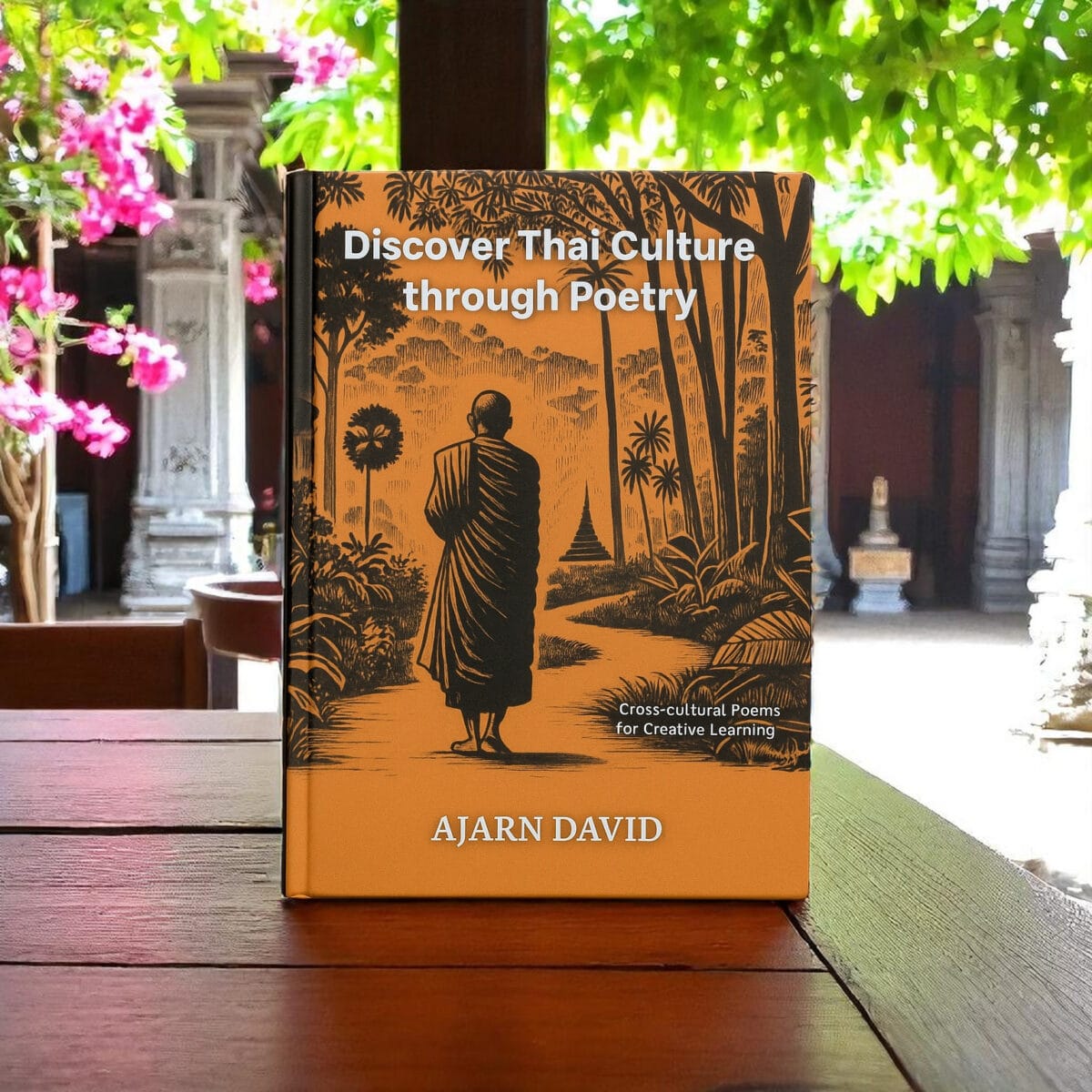
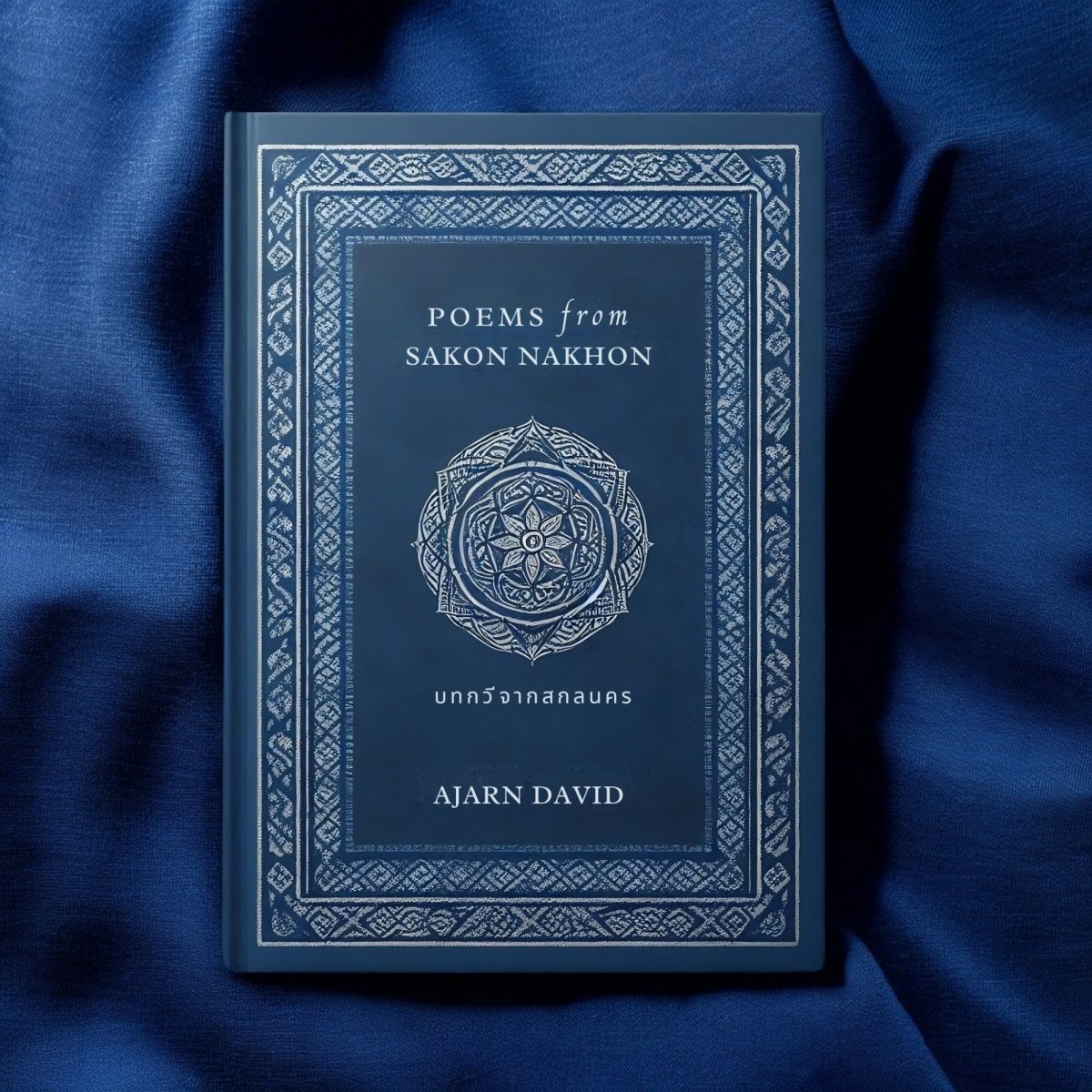
"Place Ajarn David's Thai poetry books side by side, open them to any page, and the voice is unmistakably the same. This is not as simple a thing as it sounds. A poet who moves between a book of place-poems and a book of love-poems risks losing coherence, producing two works that seem to come from different people. Ajarn David has avoided this entirely, and it is worth understanding how."

Thai Poems of Love & Loss
A
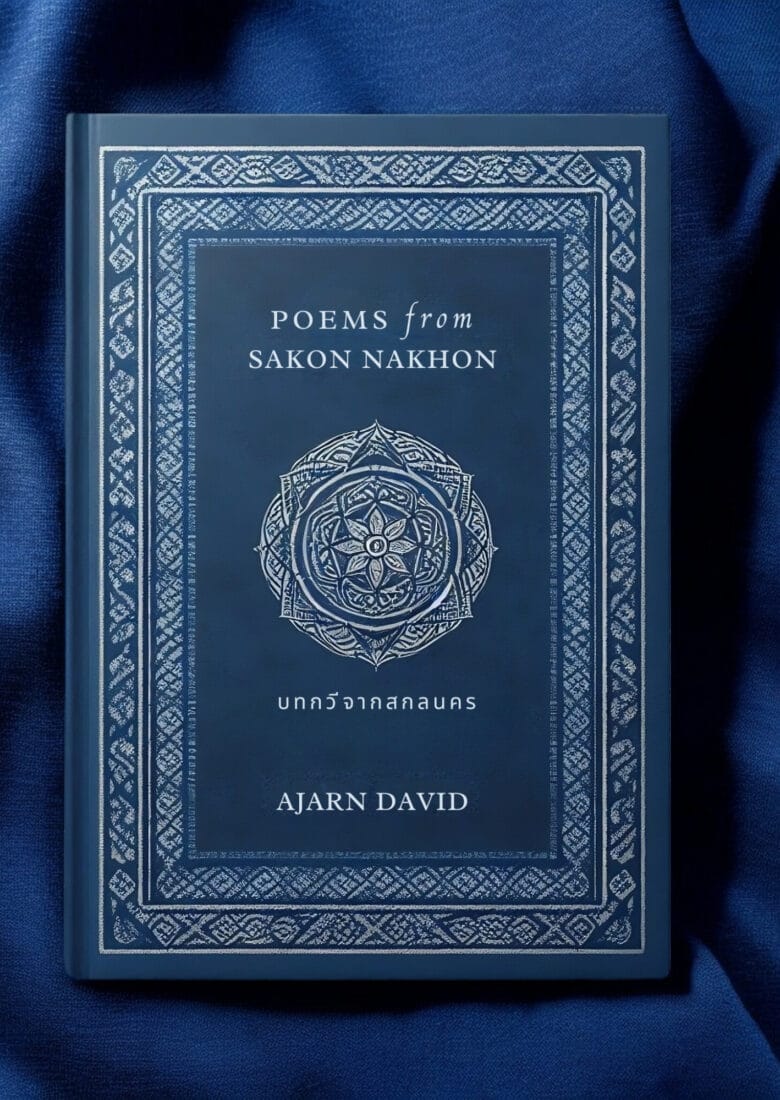
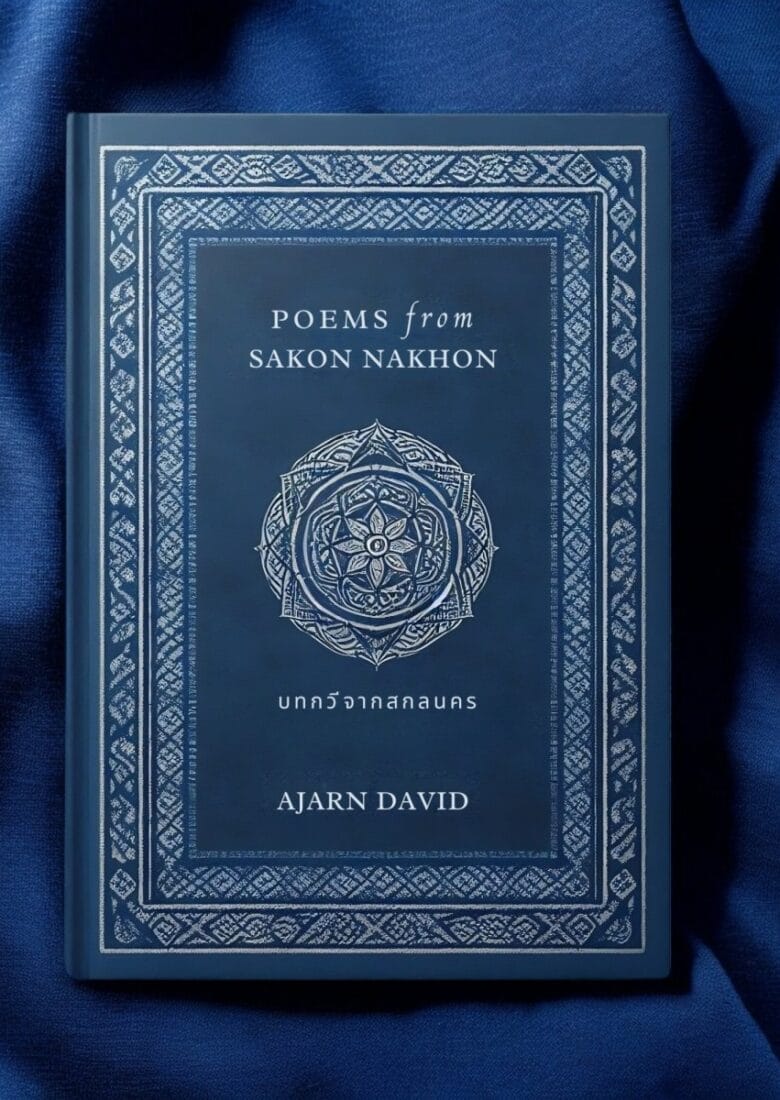
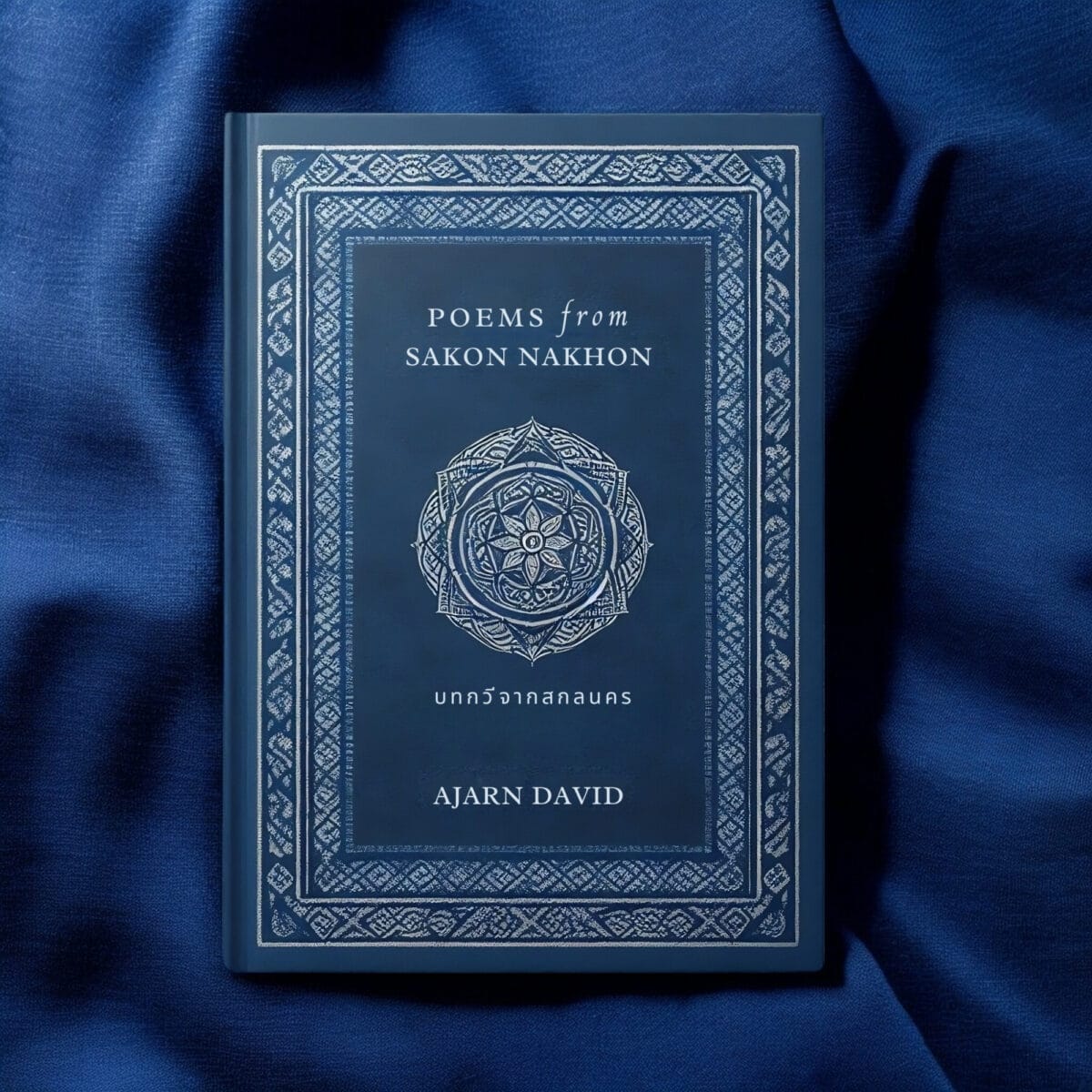
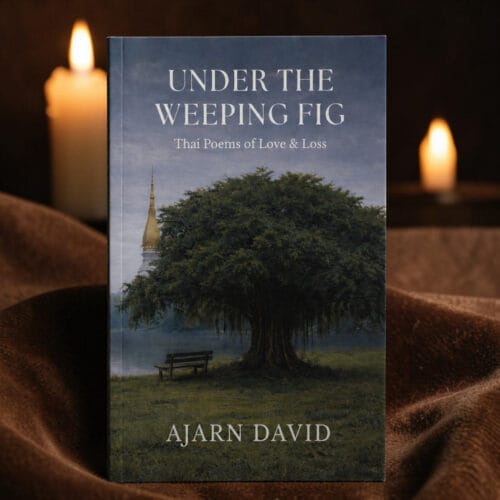
mong recent Thai poetry books, few demand more serious attention than the two bilingual collections by Ajarn David — Poems from Sakon Nakhon, published in January 2025, and its follow-up, Under the Weeping Fig.
Together they represent something rare in the world of Thai poetry: a consistent and unmistakable voice that carries across two very different books, two subjects, and two emotional worlds without losing coherence or authenticity.
As bilingual Thai poetry books go, both set a high bar — not merely rendering one language into another, but holding both simultaneously, each version alive on its own terms. What makes these collections worth examining together is precisely what connects and separates them.
Both are the work of a poet who inhabits two languages and two worlds — and what might loosely be called Thai poetry translation here is something more precise and more demanding than that phrase usually implies.
These are parallel originals, each as fully realized as the other, produced not at the clinical remove of a professional translator working from the outside but from deep inside both languages simultaneously.
What follows is an assessment of how these two collections relate to each other: what changed between them, what endured, and why together they constitute one of the more complete and honest bodies of bilingual Thai poetry that contemporary literature has produced.
What Changed: Ajarn David's Poetic World
T
he most immediately striking difference between these two Thai poetry books is their subject matter. Poems from Sakon Nakhon is essentially a portrait — of a place, its seasons, its people, its spiritual and cultural landscape.
The poems move through the rainy season's arrival, through the spirit houses and temple ceremonies and merit-making gatherings, through the forests of Phu Phan and the lakes of the province, through the lives of forest monks and market vendors and university students.
It is outward-facing, observational, and in the finest sense of the word ethnographic — a record of a world rendered with affection and precision.
Under the Weeping Fig turns inward. Its world is not a province but an interior — the landscape of love and loss as they are felt, remembered, dreamed, and endured.
Where the first collection asks "what is this place?" the second asks "what is this feeling?" Where the first collection is panoramic, the second is intimate. The shift is not a retreat — it is a deepening.
This change in focus brings with it a change in cast of characters. Poems from Sakon Nakhon is populated with observed figures — forest monks, farmers, market sellers, the revered teachers of the Thai Buddhist tradition, the students and colleagues of a twenty-year academic life. The poet is present but frequently as witness rather than participant.
Under the Weeping Fig does not so much invert this as redirect it. The poet remains fundamentally a witness — but where the first collection witnesses a place, the second witnesses an interior world: the longings, regrets, and quiet heartbreaks of the people around him.
Third-person and second-person perspectives appear as frequently as the first person throughout the collection, and many of the most affecting poems occupy the perspective of another person entirely — someone dreaming of a single perfect day away, someone finding meaning in a brief weekly encounter, a child celebrating a parent on social media, many of which bring new perspectives on the genre of unrequited love poems.
Just as Ajarn David proved himself a sensitive and precise observer of Sakon Nakhon's physical and spiritual landscape in his first collection, the second reveals that the same quality of attention has always been turned toward the people around him. The first-person voice, when it does appear, often feels like one more witness among many rather than the privileged center of the book.
Changes in Translation Style
T
he relationship between Thai and English changed fundamentally between the two books of Thai poetry, and this change is what most distinguishes them as works of Thai poetry in translation.
In Poems from Sakon Nakhon, the Thai versions were translations in the more conventional sense — accomplished, professionally edited, and genuinely valuable, but translations nonetheless. The English came first; the Thai followed.
In Under the Weeping Fig, both languages arrived often simultaneously. This is not a technical distinction but a creative one of the first order. A translated poem, however skilled the translation, always carries a slight asymmetry — one version is primary, the other derived.
A poem conceived simultaneously in two languages has no primary version. Both are originals. Both bear the full weight of the poet's intention. This shift from translation to simultaneity is the most significant technical development between the two collections, and it represents a genuine milestone in Thai poetry translations — audible in every poem.
The Thai in Poems from Sakon Nakhon employs a more literary register, drawing on formal Thai vocabulary and classical construction. This elevated diction is appropriate to poems of observation and cultural witness — the formal register honors the subjects being rendered.
Under the Weeping Fig speaks in a different Thai voice entirely — conversational, intimate, the language of friends talking quietly over a drink. It favors softening particles and everyday phrasing that no formal Thai poem would employ: the vocabulary of whispers rather than declarations.
The shift from literary to conversational Thai is not a lowering of ambition. It is a recalibration of voice to match the new emotional territory. Poems of love and loss require a different register than cultural observation, and Ajarn David has found it.
For readers approaching Thai poetry translations with the expectation of formal literary diction, this conversational intimacy will itself be a discovery.
Changes in Scale & Compression
P
oems from Sakon Nakhon is a larger collection — 91 poems against Under the Weeping Fig's 72 — and many of its individual poems are longer and more expansive.
The opening poem moves through the full ecological and social world of the rainy season's arrival, building its world detail by detail through an accumulation of landscape, wildlife, human activity, and sensory experience.
Under the Weeping Fig tends toward a more compressed form. Its longest poems are still considerably shorter than the more expansive pieces in Poems from Sakon Nakhon.
This compression reflects the new subject matter — interior emotional experience resists the patient accumulation of external detail that landscape and cultural observation invite. A feeling must be seized quickly or it slips away.
The shorter, sharper poems of the second collection are the formal consequence of turning inward. This compression also reflects a deepening of the free verse practice itself.
The line breaks in Poems from Sakon Nakhon are generally clean and functional — they divide the poem into readable units without always doing the more demanding work of creating meaning through pause and white space.
Under the Weeping Fig uses line breaks more aggressively, deploying white space to enact the very emotions being described, and returning to key phrases in ways that shift their meaning through placement alone. The formal toolkit has been refined between the two books.
Ajarn David's Umistakable Voice
A nd yet — put these two Thai poetry books side by side, open them to any page, and the voice is unmistakably the same.
This is not as simple a thing as it sounds. A poet who moves between a book of place-poems and a book of love-poems risks losing coherence, producing two works that seem to come from different people. Ajarn David has avoided this entirely, and it is worth understanding how.
The Buddhist sensibility is constant across both collections. In Poems from Sakon Nakhon, the First Noble Truth — all life is suffering — is turned toward acceptance through natural imagery.
In Under the Weeping Fig, that same sensibility appears in recurring moments of acceptance around love's impermanence, in the wisdom found in everyday objects, in the tree's laughter in the epilogue.
The Buddhist orientation is not a theme but a structural habit — a way of ending, a way of accepting, a way of finding sufficiency in what is rather than longing for what might be.
The humor is constant. Poems from Sakon Nakhon is funnier than its subject matter might suggest, and its jokes share the same comic-melancholic double movement as the best humor in Under the Weeping Fig — moments that begin as gentle comedy and arrive somewhere unexpectedly dark, or vice versa. The second collection's humor is perhaps more personal and self-deprecating, but it comes from the same temperamental source.
The love of the untranslated Thai word is constant, and it is one of the qualities that sets these Thai poetry translations apart from more conventional bilingual collections.
Poems from Sakon Nakhon introduces Thai concepts without clinical explanation, trusting the poem to carry the meaning. Under the Weeping Fig preserves Thai terms of endearment, relationship categories, and cultural references untranslated for the same reason.
In both collections, the untranslated word is not a failure of accessibility but a deliberate act of cultural trust — you feel the weight of what you don't fully understand, and that feeling is part of the poem.
The geographic rootedness is constant. Both collections are Isan books in the deepest sense. The lakes, mountains, temples, and particular quality of light in Sakon Nakhon province are not exotic backdrops in either collection but the inhabited world within which all thought and feeling take place.
A reader who knows the region will find both books alive with recognition. A reader who doesn't will find both books opening a world that feels genuinely inhabited rather than performed — which is, ultimately, what the best Thai poetry in translation always does.
The Arc Between These Thai Poems
P
oems from Sakon Nakhon ends in striking solitude — the poet alone in a candlelit room during a monsoon, in the company of the dangerous and the sacred, writing his last poem from that place. It is a beautiful and appropriately mysterious ending.
Under the Weeping Fig, a book of Thai love poems, opens with a question about what a poem should be, and closes with an invitation — imagining future reunion, laughter and love rather than grief.
The first book ends in solitude. The second book ends in imagined togetherness. That arc — from solitary witness of a place to intimate address of a beloved, from the external world rendered with precision to the internal world rendered with equal precision — is the arc of a poet who has continued to grow between books.
The second collection is not a departure from the first. It is the same sensibility, the same voice, the same love of the specific and the honest and the quietly humorous — turned, now, toward the innermost things.
Poems from Sakon Nakhon announced a poet who could see a place with extraordinary clarity. Under the Weeping Fig announces that the same poet can see a feeling with the same clarity.
Together, these two Thai poetry books constitute one of the more complete literary portraits of a life lived between two languages and two worlds that contemporary poetry in translation has produced.