"In Under the Weeping Fig, Ajarn David has produced something his literary predecessors of unrequited love could not: a vision of one-sided love that is not tragic, not pathological, not consuming, but quietly sufficient — and in its sufficiency, genuinely beautiful."
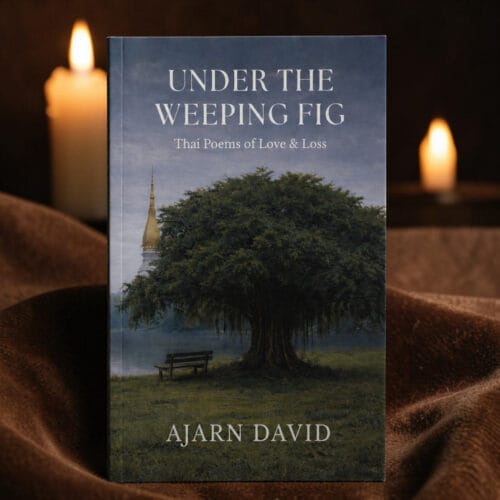
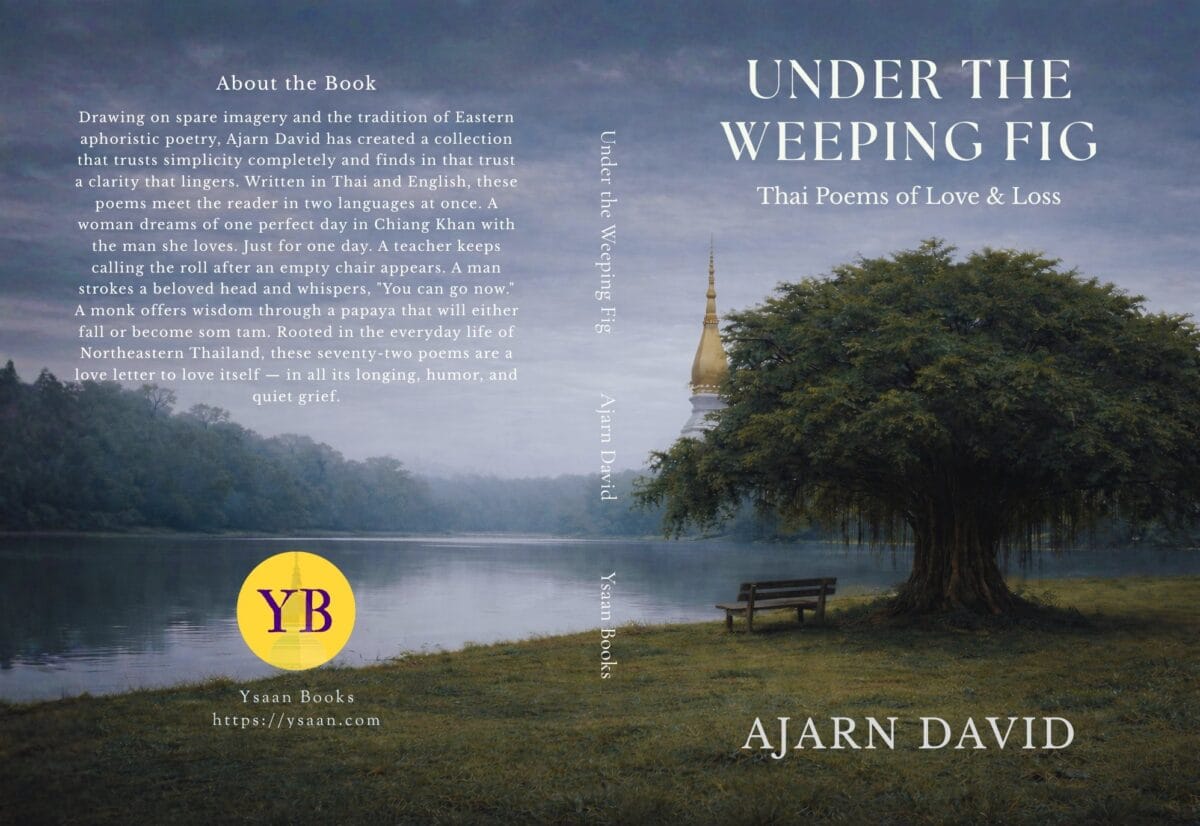
Thai Poems of Love & Loss
U
nder the Weeping Fig is a bilingual poetry book that can be viewed as an eloquent and unique collection seventy-two unrequited love poems.
Written in both Thai and English by Ajarn David, a poet shaped by decades of life in Northeast Thailand, the poems move through familiar landscapes — temple grounds, quiet roads, lakesides, and everyday encounters — while reflecting on love, memory, and the small, often overlooked moments that give emotional life its texture.
However, there is a reading of the book that its author has not advertised but has not entirely hidden either. Although Ajarn David is himself a happily married man and devoted father, the collection offers a sustained imaginative exploration of one-sided, unrequited love in Thailand.
It requires stepping back from the individual poems — each of which is complete in itself, each of which rewards close attention on its own terms — and asking a different question: not what does this poem mean, but why is this poem here, in this book, alongside these other poems, addressed to this unnamed person who never quite appears and never quite responds?
When that question is asked consistently across all seventy-two poems, a shape emerges that the collection’s subtitle — Thai Poems of Love & Loss — only partially describes.
What emerges is a single sustained poem of unrequited love: one poet, one beloved who does not return his feeling in kind, and seventy-two movements through every emotional, philosophical, humorous, and elegiac register available to a person in that position.
The collection is, in this reading, not an anthology of related poems but a unified emotional work — the most complete portrait of unrequited love in contemporary bilingual poetry, and one of the more honest such portraits in any language.
This essay makes that case, examines the evidence, considers why the poet chose to obscure rather than announce this reading, places the work in the context of literature’s most famous treatments of unrequited love, and argues that what Ajarn David has produced ultimately delivers something those famous predecessors could not: a vision of one-sided love that is not tragic, not pathological, not consuming, but quietly sufficient — and in its sufficiency, genuinely beautiful.
Clues from the Unrequited Love Poems
T
he evidence that Under the Weeping Fig is organized around a single unrequited love is distributed across the collection with the care of someone who wanted it findable but not obvious. It is assembled, like a portrait, from fragments — each innocent in isolation, each unmistakable in accumulation.
A Single You
The most immediate clue is the consistency of address. Across seventy-two poems, the second person — you, เธอ, น้อง — refers to what feels unmistakably like the same person. The you who is told that his love is enough for him even if it isn’t enough between them appears alongside the same presence glimpsed in absence and imagined in a life that may not include him.
This consistency of address is not the norm in poetry collections, even love poetry collections. The emotional texture of the you (sometimes referred to in the second person) across all seventy-two poems — her smile, her occasional indifference, her Facebook presence, her motorcycle, the sound of her name — accumulates into a specific person rather than a type.
We never learn her name. But we learn her extremely well.
The Asymmetry That Never Resolves
The love in this collection is consistently and deliberately one-directional. The poet gives. The beloved receives, or doesn’t, or doesn’t know. The emotional traffic moves in one direction across the entire book without ever reversing.
Poem #8 states this with its governing metaphor early enough to frame everything that follows: the beloved moving through her life, the poet at a particular angle to it. That asymmetry — her direction, his position — is the essential dynamic of the entire collection.
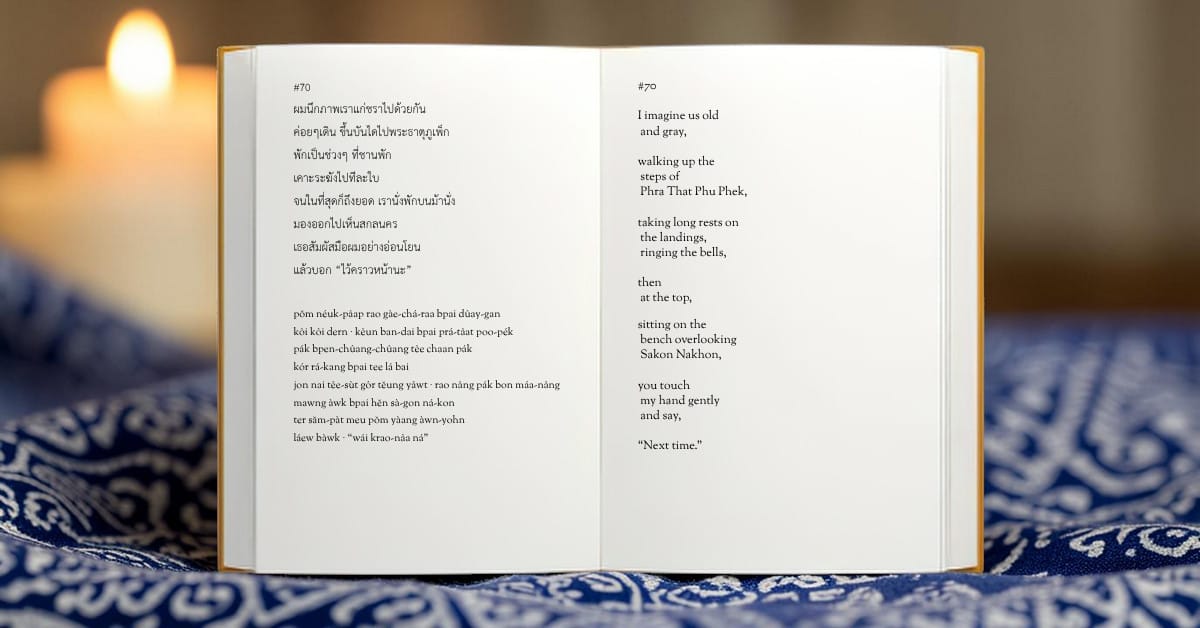
Poem #26 describes the specific emotional posture of unrequited love with unusual precision — the patience, the proximity, the chosen limits — and names what the poet has made of it: his quiet love and what he calls his “perfect angst.”
The Poems About Not Being Known
Poem #35 is perhaps the most explicit: the poet tells the beloved that he knows she doesn’t understand why he loves her, but that it’s better this way. The beloved’s not-knowing is presented not as a problem to be solved but as a condition to be maintained.
The book is structured around the same protective logic as the love it describes: say everything, but say it in a way that gives the beloved deniability.
Poem #38 tells us that when the poet thinks of her, what comes is not her smile or her searching eyes, but a single image of absence — one of the most precise images of unrequited love in the collection, and the one that most honestly names the lover’s relationship to the beloved’s presence.
The Poem That Names It
Poem #6 — placed early, unmissable, the collection’s most self-aware moment — defines the very condition the book is exploring. It contrasts the English term “unrequited love” with the Thai “ruk kahng dio” (one-sided love), and finds the Thai superior: less needy, truer to love’s nature, which the poem proposes is always one-sided and asks nothing in return.
This poem does not say “my love is unrequited.” It says something more philosophically ambitious: that all love is one-sided in its essence, that love which asks nothing in return is closer to love’s true nature than the reciprocal arrangements we usually call by that name.
This is both a description of the collection’s emotional situation and a pre-emptive philosophical defense of it.
Unrequited Love Poetry & The Art of Concealment
I
f Under the Weeping Fig is organized around a single unrequited love, why didn’t Ajarn David say so? Why the subtitle Thai Poems of Love & Loss rather than something more revealing? The answer operates on several levels simultaneously.
Protection of the Beloved
The most practical reason for concealment is the most human: the beloved is a real person. She lives in Thailand. She may read Thai. She almost certainly has not been told, in the direct terms a reader can now infer from the collection, the full extent and duration of what the poet feels.
By distributing the feeling across seventy-two poems, by shifting pronouns, by inserting philosophical and humorous poems and poems about other people’s loves, the poet has written a complete emotional truth while preserving both his own dignity and hers
However, since the author is married, it could be an unrequited love from his past, who he would like to conceal.
The Universal Made Personal
A collection that announced itself as a sequence about one unrequited love would risk the narrowness of the personal. By writing poems that feel universal, the poet has made the particular feeling available to every reader who has ever loved without full return.
The disguise is also, paradoxically, what makes the collection most true. Because unrequited love is partly defined by its invisibility — felt fully by one person and not at all by the other — a book that hides its own organizing feeling is formally faithful to its subject. The love is present on every page, and the beloved doesn’t quite see it.
The Poet as Witness of Himself
Throughout both his collections, Ajarn David operates fundamentally as a witness — of place, of people, of culture, of feeling. Even in his most personal poems, he tends to observe rather than confess. He watches himself love this woman the way he watches a man wait patiently in a noodle shop for paths to cross.
The shift from “I” to “he” or “you” in poems that feel autobiographical is not evasion but witness. Poem #26, with its portrait of a man’s quiet love and “perfect angst,” reads as autobiography precisely because the detachment is so affectionate and so exact.
How This Reading Transforms the Love Poems
R
eading Under the Weeping Fig as a sustained poem of unrequited love does not diminish the individual poems — it deepens them. Each poem that seemed to stand alone now stands in relation to a larger emotional architecture.
The Philosophical Love Poems as Survival Strategies
The collection’s aphoristic and Buddhist teaching poems become, in this reading, survival strategies. Poem #24’s teaching that love means traveling light, carrying only kept promises, is not general advice. It is what a person tells himself when the love he carries cannot be set down and cannot be reciprocated.
“Don’t try” — the entire argument of Poem #25 — is, in this context, the hardest and most necessary thing: don’t try to make her feel what she doesn’t feel, don’t try to force reciprocity, allow it to be.
The Humorous Love Poems as Healthy Distance
The collection’s humor takes on a different quality in this reading. These poems are not mere tonal relief. They are the healthy distance that prevents the collection from becoming suffocating — the poet laughing at himself, at the situation, at the universal absurdity of loving without return.
The hopeless romantic of Poem #19, pulled between inner voices — one urging him to act, a louder and more rueful one chastising him for having gone too far — is a self-portrait drawn with sufficient distance to be funny. Goethe’s Werther could not manage this. He died.
The Other People’s Love Stories as Mirrors
Many of the collection’s most affecting poems are ostensibly about other people’s loves — the woman dreaming of one day in Chiang Khan, the couple walking silently along Nong Han Lake, the man who chants the katha of Phra Khun Paen every morning.
In this reading, these are not merely observations of the world’s variety of love — they are the mirrors in which the poet examines his own feeling from the outside.
The Death Poems as Perspective
The two death poems — Paw Ruay dying at home surrounded by love, a beloved given permission to go — perform a specific function: to remind both the poet and the reader that unrequited love, however real and persistent, is not the worst thing. Against these deaths, the poet’s one-sided love is placed in perspective — it is real, it matters, it will be carried — but it is not tragedy.
Unrequited Love in Poetry & Literature
U nder the Weeping Fig enters a long and distinguished literary tradition. Unrequited love has produced some of literature’s most enduring works precisely because it generates a particular kind of sustained and inward-turning attention — the lover, having nowhere to direct his feeling outward, turns it into language.
The tradition runs from Petrarch’s sonnets to Laura, through Shakespeare’s darker and more conflicted love poems, through Goethe’s Werther, Keats’s odes, and Neruda’s Twenty Love Poems and a Song of Despair.
Across these works, unreturned love is not a marginal theme but a central engine of literary expression. What changes from writer to writer is not the feeling itself, but the shape it takes.
The Sorrows of Young Werther: Love as Consumption
Goethe’s Werther established what might be called the dominant Western template for unrequited love: totalizing, escalating, and ultimately self-destructive. Werther loves Charlotte. She cannot return that love. He cannot accept the boundary this creates, and the imbalance becomes unbearable.
The result is not equilibrium but collapse. The feeling expands until it consumes the lover entirely. The tragedy lies not only in the love being unreturned, but in the lover’s inability to survive that fact.
This model has been enormously influential, shaping the idea that unrequited love is, by nature, unsustainable.
Petrarch and the Beloved as Ideal
The Petrarchan tradition offers a different resolution. Petrarch’s Laura is distant, largely inaccessible, and ultimately unattainable — but the love she inspires becomes a force of refinement rather than destruction.
Here, the beloved is elevated into an ideal. The lover’s attention transforms into poetry, devotion, and spiritual aspiration. The love remains unreturned, but it is productive rather than consuming.
Yet this comes at a cost. The beloved becomes less a person than a symbol — more muse than woman — and the relationship, such as it is, exists primarily within the lover’s imagination.
Shakespeare and the Problem of Imbalance
Shakespeare’s sonnets, particularly those addressed to the so-called Dark Lady, complicate both models. Here, love is neither purely ideal nor purely elevating. It is unstable, often frustrating, and marked by imbalance, desire, and contradiction.
The beloved is neither distant nor perfect. She is present, inconsistent, and not fully aligned with the speaker’s feeling.
The result is a more psychologically complex portrait of love that does not resolve cleanly into either transcendence or destruction. This tension — between attachment and awareness — moves closer to the emotional terrain Under the Weeping Fig explores.
Neruda and the Poem as Possession
Pablo Neruda’s Twenty Love Poems and a Song of Despair offers another variation: love as an act of linguistic possession. The beloved is held in language with such intensity that the poem itself becomes a form of presence.
Even when the relationship dissolves, the beloved remains — fixed, vivid, and enduring within the poem. The act of writing becomes a way of holding what cannot be held in life.
Under the Weeping Fig gestures toward this idea, but subtly reframes it. What is carried forward is not possession, but attention — a sustained awareness that does not attempt to replace or contain the beloved.
Keats and the Beauty of the Unfulfilled
Keats approaches unrequited love from yet another angle: the idea that what is not fully realized may, in some sense, be preserved. The lovers on the Grecian urn are most fully in love at the moment before fulfillment. The unrealized becomes permanent.
This insight — that completion may diminish what longing sustains — runs quietly through Keats’s work, and echoes in poems that find a strange stability in what remains unresolved.
Gatsby and the Illusion of Return
In The Great Gatsby, unrequited love takes the form of illusion. Gatsby’s love for Daisy is not only unreturned — it is built on a past that cannot be recovered. He does not accept the asymmetry; he attempts to overwrite it.
The result is a love that depends on denial. When reality intrudes, the structure collapses. This stands in sharp contrast to Under the Weeping Fig, where the asymmetry is not resisted or rewritten, but gradually understood.
Unrequited Love in Under the Weeping Fig
W
hat ultimately distinguishes Under the Weeping Fig within this tradition is not the presence of one-sided love, but the emotional and philosophical stance the poet is able to sustain within it.
It Does Not Privilege the Lover’s Suffering
In much of the unrequited love tradition, the lover’s suffering becomes the center of gravity. The beloved matters primarily as the source of that suffering.
Here, that dynamic is quietly reversed. The beloved is imagined as a full person with her own inner life, her own world, her own future. The poems return, again and again, to her autonomy — to the simple fact that her life continues independently of the poet’s feeling.
Her happiness is not contingent on his presence in it. And the poems do not attempt to change that. This shift is subtle, but decisive. The attention moves outward, rather than circling inward.
It Has a Sense of Humor
The literature of unrequited love has often been marked by seriousness — even severity — as if intensity of feeling required the absence of distance. Ajarn David allows for something else. He observes its own condition with clarity, and at times with humor.
The poet is not outside the feeling, but neither is he entirely consumed by it. This capacity for distance changes the emotional register of the work. It makes room for movement, for reflection, and for a kind of balance that the more tragic models cannot sustain.
It Finds Sufficiency
The most significant departure from the tradition lies in where the collection ultimately arrives. In many of the works that precede it, unrequited love demands resolution. It must be fulfilled, transformed, or escaped. Without that, it becomes unbearable.
In Under the Weeping Fig, the asymmetry remains, but it is neither corrected nor denied. And within that space, the poems gradually suggest another possibility: that the act of loving — of paying attention, of holding another person in awareness without possession — may be complete on its own terms. Not triumphant. Not resolved. But sufficient.
A Prophecy in Poems from Sakon Nakhon
T
here is a remarkable poem in Ajarn David's first collection, Poems from Sakon Nakhon, that only fully reveals its significance in retrospect — once Under the Weeping Fig exists.
Poem #30 of that collection describes a young man overcome by unrequited love, sitting in quiet defeat. It reflects on a moment many people eventually face: the choice between remaining consumed by a love that cannot be returned, or transforming that feeling into something meaningful and enduring.
Rather than surrendering to despair, the poem suggests redirecting that emotional energy into creating something of value — something that can stand on its own, independent of the love that inspired it.
This poem was written in 2024. Under the Weeping Fig was published in 2026. And yet the earlier poem reads now as nothing less than a creative manifesto for the book that followed it — as if the poet, watching a young man broken by unrequited love, was simultaneously watching himself and prescribing his own remedy.
The advice the poem offers is precise: don't remain in dejection, don't be defeated by love that is “hopelessly out of reach,” but take that love and direct it into the making of something new — something precious, something worthy of love in its own right.
Under the Weeping Fig is exactly that something. It is what happens when a poet takes unrequited love and, rather than collapsing under it or raging against it, directs it into seventy-two poems of extraordinary precision and tenderness.
This retroactive reading transforms the relationship between the two books. Poems from Sakon Nakhon is not merely a predecessor to Under the Weeping Fig — it contains the seed of the second book's creation, the moment when the poet understood what he would do with the feeling that had no other outlet.
The young man with his head in his hands is observed from the outside in the earlier poem. The second book is what happened when the poet took his own advice. It also deepens the second collection's implicit argument.
Under the Weeping Fig does not just survive unrequited love — it transforms it. The love that “asked nothing in return” becomes, in the act of the collection's creation, something that does return: seventy-two poems that will outlast the feeling that generated them, that will be read by people who have never met the beloved or the poet, that will give language to emotional experiences readers recognized but could not articulate.
The love was one-sided. The poems are not. They belong to everyone who reads them. This is the alchemy that Poem #30 of Poems from Sakon Nakhon predicted, and that Under the Weeping Fig accomplished.
Love Poems of Resolution Without Reciprocity
T
he final poem — Poem #72 — is the collection’s most generous gesture. It reaches toward the beloved across the distance the whole book has maintained, asking for nothing she did not already have to give.
This collection of Thai love poems closes in acceptance rather than resolution: a love that has made peace with its own asymmetry, that wishes the beloved joy in a world that may not include him. The entire arc, read as a single poem of unrequited love, is an extended act of metta — loving-kindness, defined as love that wishes happiness to its object without condition or expectation of return.
That movement toward acceptance does not end with the final poem. It continues, in a quieter form, in the brief encounter that closes the book.
In the "Epliogue," the poet goes into the forest seeking guidance. He has just finished a book that is, among other things, a seventy-two poem love letter to someone who may not know she has received it.
He bows before the ancient tree. The tree responds — and what it says reframes everything that came before it.
Read against the full arc of the collection, the tree’s words are not a surprise. It is a confirmation — of the capacity to feel this fully, to love this honestly, to write this precisely, as something to be grateful for rather than mourned.
The Thai perspective has always been better: ruk kahng dio. One-sided love. Not failed love. Not tragic love. Not love that demands completion to justify itself. Love that is complete in itself, on its own side, already whole.