"It's useful to situate Ysaan Books' bilingual poetry collections alongside the major traditions that currently populate recommendations for bilingual poetry books, because the similarities and differences are both instructive."
From García Lorca to the Isaan Fields of Thailand
I
f you've spent serious time with bilingual poetry books, you know the feeling: that particular pleasure of reading the same poem twice — original text on one side, translation on the other — and realizing it isn't quite the same poem at all.
Something is always present in one version that the other can only approximate. The gap between them — that charged, untranslatable space where both languages reach toward the same feeling — is where the real conversation happens.
This guide explores the landscape of bilingual poetry books: what makes the genre work, who has pushed it furthest, and why a small independent press in northeastern Thailand is producing some of the most genuinely unusual bilingual poetry collections available in English today.
What Makes a Great Bilingual Poetry Book?
B
efore diving into specific collections, it's worth establishing what we're actually asking for when we pick up a bilingual poetry book.
On the surface, it seems simple: poems in two languages, presented side-by-side so readers can compare. But the best bilingual poetry books are doing something far more interesting than comparison shopping.
They're arguing — through their very form — that feelings don't translate cleanly. That certain emotional truths can only be fully inhabited from within a specific language. That the act of reading across two versions simultaneously teaches you something about both languages that reading either alone never could.
The Spanish/English tradition has given us the most celebrated examples, and for good reason. When García Lorca's Poet in New York appears in bilingual editions, with Christopher Maurer's careful assembly of new translations placed beside the original Spanish, readers encounter the full force of Lorca's surrealism in both registers at once.
The Spanish originals carry a music — a propulsive, tonal density — that even the finest English renderings can only gesture toward. Having both on the page isn't a crutch; it's an argument for why the original matters.
Pablo Neruda's bilingual editions present a similar case. His 100 Love Sonnets, rendered in parallel Spanish and English by Stephen Tapscott, allows readers to hear how differently the same erotic charge lands in each language — how Spanish sustains a particular kind of earthbound lyricism that English tends to intellectualize.
And in his Essential Neruda — edited by Mark Eisner with translations by nine poets including Robert Hass, Alastair Reid, and Stephen Mitchell — the side-by-side bilingual format across fifty poems creates something almost orchestral: different translators' voices bringing different poems to life, together conveying the full arc of Neruda's poetic career.
Eduardo C. Corral's Slow Lightning, recommended in countless bilingual poetry roundups, pushes the genre in a different direction — toward borderland identity, toward language itself as a site of political and personal tension.
The Persian collections from Mage Publishers — Hafez's Faces of Love, the sweeping anthology The Mirror of My Heart — offer readers an entirely different tradition: one where the classical forms carry centuries of accumulated meaning that even the best English translations must necessarily abbreviate.
These are essential collections. But they all share one structural feature: one language arrived first, and the other followed. Translation, however skilled, however faithful, carries the weight of that secondariness. The original poem exists; the translation serves it.
When Both Languages Arrive at Once
H
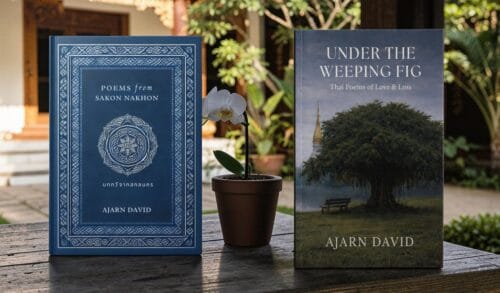
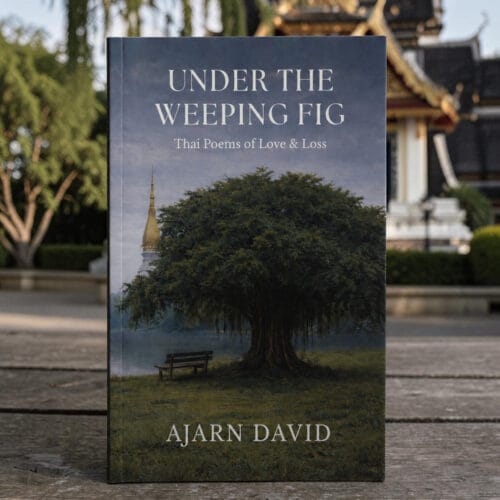
ere is where Ajarn David's two bilingual poetry books from Ysaan Books, Poems from Sakon Nakhon and Under the Weeping Fig, occupy genuinely new ground in the genre.
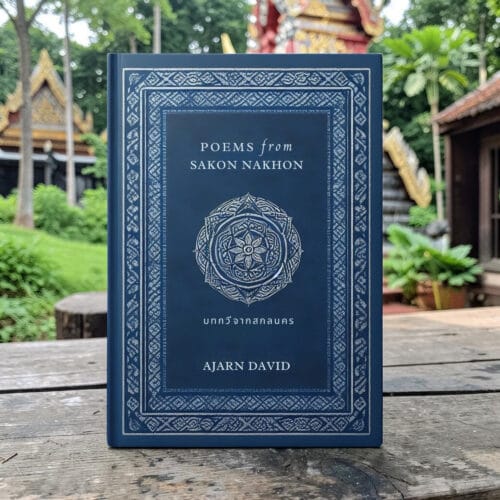
The two collections arrived differently, and this distinction matters. Poems from Sakon Nakhon was written in English first; the Thai versions were created afterward as translations.
Under the Weeping Fig took a different path: its poems were largely composed simultaneously, with the poet's mind moving back and forth between Thai and English as they took shape. The English lines tended to arrive as nearly complete poems; the Thai emerged more as rough sketches, filled in and refined over time.
As Ajarn David explains in his preface, the two versions are therefore not direct translations of one another, but parallel expressions of the same experience — each shaped by the unique nature of its language.
The significance of this distinction — particularly for Under the Weeping Fig — cannot be overstated for anyone who reads bilingual poetry books carefully.
In Neruda's bilingual editions, Spanish is primary and English is service. In Corral's Slow Lightning, English is primary and Spanish erupts into it as a second voice. In Poems from Sakon Nakhon, English arrived first and Thai followed — an honest, skilled translation, but one with a clear direction of travel.
In Under the Weeping Fig, there is no such hierarchy of origin. Reading across both versions, you're not following a poem and its translation — you're catching the same feeling arriving from two directions at once. This is, to put it plainly, extremely rare in the history of bilingual poetry books.
Poems from Sakon Nakhon: Place as Poetic Foundation
P
oems from Sakon Nakhon — the first of Ajarn David's Ysaan Books releases — is, in the most literal sense, a book about where he lives.
Sakon Nakhon is a province in Thailand's northeastern Isaan region that most travel guides mention only in passing. Its landscapes are not the postcard Thailand of beach resorts and urban temples. They are rice fields and monsoon rains, village markets and forest monasteries, rivers and the quiet rhythms of agricultural life lived close to Buddhist practice.
The collection's 91 poems move through this world with a clarity that earns comparison to the compressed observation of Japanese haiku and Korean sijo — traditions that bilingual poetry books have long celebrated for their ability to hold enormous feeling in small formal containers.
Like those traditions, Poems from Sakon Nakhon relies on precise, unadorned images to do the work that more rhetorically elaborate poetry spreads across stanzas. A monsoon transforms the landscape; fish appear in flooded fields like gifts from the sky; a grandmother's hands read like a history book of a simple but storied life.
The poems don't editorialize about these images. They present them and trust the reader. What makes this particularly interesting as a bilingual poetry collection is what happens in the Thai versions.
The Thai free verse (กลอนเปล่า) in Poems from Sakon Nakhon embodies the characteristics of contemporary Thai poetry — short lines, natural rhythms, unforced enjambment — while remaining unmistakably Thai through subtle soundplay and regional imagery.
Critics have placed the collection in conversation with Naowarat Pongpaiboon, the celebrated National Artist whose nature-rooted reflections share a similar meditative musicality, and with Phaiwarin Khao-ngam, the acclaimed Isaan poet whose work blends rural memory, Buddhist reflection, and accessible free verse.
But there's an equally important divergence to note: unlike the classical Thai tradition represented by poets like Sunthorn Phu and Angkarn Kalayanapong — whose dense meter, classical rhyme schemes, and elevated literary language place considerable demands on readers — Poems from Sakon Nakhon writes in a way that's genuinely accessible to international readers and Thai-language learners alike.
This is not a failure of ambition. It's a considered formal choice, and one that gives the bilingual poetry collection its particular value as a bridge between cultures.
Among the most striking formal features of Poems from Sakon Nakhon in the context of bilingual poetry books more broadly: only five of its 91 poems use the first-person "I."
This is a radical departure from the dominant tradition of Western poetry, where the lyric "I" — Wordsworth's "I wandered lonely," Whitman's "I celebrate myself," Plath's intensely confessional first person — is so fundamental it can seem like the genre's defining feature.
By contrast, Ajarn David's poems look outward. They attend to the world rather than using the world to attend to the self. This disposition is rooted in Buddhist philosophy — specifically in the concept of anatta, or non-self — and it gives the collection a quality that feels genuinely foreign to Western poetic expectations.
Which is, of course, precisely the point: a bilingual poetry book in Thai and English has an obligation to let Thai sensibility shape the English as much as English shapes the Thai.
Under the Weeping Fig: Love, Language & Thai Feelings
P oems from Sakon Nakhon is about place, Under the Weeping Fig turns inward toward the emotional territory that follows from a life lived in Isaan.
Its subtitle — Thai Poems of Love & Loss — gives the subject, and its 72 poems navigate it with a consistency and cumulative force that sets it apart from most bilingual poetry collections organized around a theme.
The beloved who moves through these poems — suggested consistently by the Thai pronouns เธอ and น้อง — has chubby cheeks and doesn't see her own beauty. She has a Facebook presence that resurfaces precisely when the speaker has almost stopped thinking of her. She forgets plans they had made. She has a motorcycle. She has a name the poems never give us, and yet by the end of the collection, readers know her extremely well.
This is not a generalized romantic subject. It is one woman, seen across 72 angles of approach, by someone attending to her with great care and very little expectation of return. That asymmetry — love offered fully, received in some different register — brings us to one of the most genuinely illuminating aspects of this collection in the context of bilingual poetry books: what it reveals about the relationship between language and feeling.
One poem makes the argument directly. It places the English term "unrequited love" alongside the Thai รักข้างเดียว — literally "one-sided love" — and makes a careful, patient case for why they are not the same thing.
"Unrequited" is dense with expectation and its disappointment. It implies that love has been submitted for consideration and found wanting — a transaction gone wrong. The Thai simply locates the love on one side. It doesn't complain. It doesn't require reciprocity in order to be complete.
This is the kind of observation that bilingual poetry books rarely make so directly: that the language we use to name a feeling shapes the feeling we're capable of having. English wants resolution.
Thai is more comfortable leaving the door open, the moment unfinished, the conclusion unannounced. And Under the Weeping Fig lives in that space — present but unexplained, felt but not argued.
The comparison to Western literary treatments of unrequited love is instructive. Goethe's Werther, perhaps the most famous example in European literature, presents unreturned love as totalizing and ultimately fatal. Werther cannot love without being consumed by love's asymmetry.
Petrarch spent decades writing sonnets to Laura, who remained largely inaccessible; his suffering was the subject. Even the self-aware contemporary versions of this theme — the friend zone, the one-sided attachment — tend toward lamentation or wry resignation.
The Thai love poems in Under the Weeping Fig reach a different conclusion: that attachment to particular outcomes — including reciprocity — is itself the source of suffering, and that love which has released that attachment hasn't diminished but purified itself. One-sided love. Not failed love. Love that is complete on its own side.
For readers of bilingual poetry books who've encountered this territory only in Western or Latin American contexts, this framing will feel genuinely new. It emerges from a specific place — a Buddhist culture in which the capacity to love without grasping is considered not a failure of nerve but a spiritual achievement — and both the English and Thai versions of the collection carry that understanding without announcing it.
Comparison of Bilingual Poetry Books
I
t's useful to situate Ysaan Books' bilingual poetry collections alongside the major traditions that currently populate recommendations for bilingual poetry books, because the similarities and differences are both instructive.
The Spanish/English tradition is the most established in English-language literary culture, for obvious historical and demographic reasons. Collections from Lorca, Neruda, Corral, Johanny Vásquez Paz, and many others have created a rich conversation about language, identity, migration, and the politics of who gets to speak and in what tongue.
What these collections share — even when they differ dramatically in aesthetics — is a sense of language as contested territory. Spanish and English in the Americas carry enormous historical weight. The choice to present them side by side is always also a political statement.
Ajarn David's bilingual poetry books have a different relationship to politics. Thai and English don't carry the same fraught colonial history as Spanish and English in North and South America. The tension in these collections is cultural and philosophical rather than political. What gets examined is not power but perception — the way Thai sensibility shapes what love means, what loss means, what it means to let things be.
The Persian/English tradition, represented beautifully by Mage Publishers' collections, offers classical poetry in translation — centuries-old verse rendered accessible to modern English readers. These bilingual poetry books work by building a bridge across time as much as across language, giving Western readers access to Hafez and the great women poets of the Persian tradition.
The Thai-English collections from Ysaan Books are doing something different: bringing a living contemporary voice from a region and tradition that international literary culture has largely overlooked.
The Asian literary parallels are also worth noting. Poems from Sakon Nakhon has drawn comparisons to haiku and sijo — traditions that bilingual poetry books in Japanese/English and Korean/English have explored extensively. The compressed observation, the trust in concrete image over abstract statement, the Buddhist comfort with impermanence: these qualities genuinely connect Ajarn David's work to those traditions.
But his poems are also more socially embedded than haiku — more rooted in the textures of daily life, in humor, in the specific personality of Isaan culture — and the bilingual Thai/English format gives readers something that Japanese/English or Korean/English collections cannot: a chance to encounter a living language from a culture that remains genuinely unfamiliar to most Western readers.
The "outsider-insider" perspective that critics have used to describe Ajarn David's position — someone with enough distance to notice what locals take for granted, and enough immersion to write from within rather than above — also distinguishes these collections from most bilingual poetry books.
Most collections are either the poet writing in their native language (Neruda's Spanish, Hafez's Persian) or a translator mediating between cultures they may know deeply but inhabit differently.
Ajarn David has spent more than two decades in Thailand, is married to a Thai woman, teaches at a Thai university, and writes Thai as a language of genuine poetic expression. That combination of genuine cultural immersion and maintained outsider perspective is genuinely rare in bilingual poetry publishing.
Ysaan Books and the Question of Literary Geography
S
omething worth saying about the publishing context: Ysaan Books is a small independent press based in Sakon Nakhon, Thailand, whose stated mission is to promote the arts, culture, and people of the Isaan region through literature, poetry, and non-fiction. It occupies a space that no international publisher has been in any hurry to fill.
Most of the bilingual poetry books that appear in major recommendations are published by established American or European presses — Farrar, Straus and Giroux; Copper Canyon; Milkweed; New Directions; Grove Atlantic; university presses with strong poetry lists.
These publishers have the reach to place collections in front of international audiences, the marketing infrastructure to generate critical attention, and the institutional relationships that lead to awards, reviews, and course adoptions.
Ysaan Books has none of these advantages, and its collections represent a region and tradition that has virtually no presence in the international literary conversation.
But what it does have is genuine knowledge of Isaan — its landscapes, its people, its culture, its Buddhist philosophy, its specific emotional registers — and a poet who has spent more than two decades earning the right to write from inside rather than above.
The argument that Poems from Sakon Nakhon and Under the Weeping Fig belong in the conversation about the best bilingual poetry books currently available is not about institutional prestige. It's about what the genre is for.
Bilingual poetry books, at their best, give readers access to emotional and perceptual territory that monolingual reading forecloses. They argue that how a language holds a feeling shapes the feeling itself. They create space for two ways of knowing to inhabit the same page.
On those terms, both Ysaan Books collections are doing exactly what the genre's finest examples have always done — and doing so from a linguistic and cultural combination that, before these books existed, had no serious bilingual poetry presence at all.