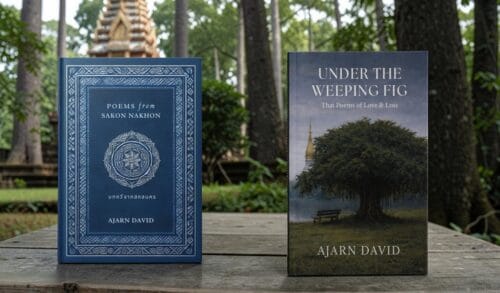
"Ajarn David's journey is both physical and metaphysical. Poems from Sakon Nakhon is rooted in the landscape of northeast Thailand — the monsoon rains, the flooded rice fields, the mountain mists, the indigo hues of the countryside — while Under the Weeping Fig represents a movement inward, increasingly concentrated on the interior landscape of love, loss, and longing."
The Journey, the Longing, and the Forest
S
omewhere in the forests of the Phu Phan mountains in Sakon Nakhon, a poet is talking to trees.
He’s two days into a five-day fast. The night before, he dreamed he should talk to the trees, so he’s doing that. One gangly tree sends him further down the path, where he finds a massive old trunk shaped like a face — wide watchful eyes, a mouth like an axe-blow. He bows. The tree laughs and speaks first.
This is how Under the Weeping Fig ends — not with a poem, but with an epilogue in the forest. It’s also, this article will argue, where the journey that began in the first collection finally comes to rest.
That journey — across two books, ninety-one poems in Poems from Sakon Nakhon (2025) and seventy-two in Under the Weeping Fig (2026) — has the shape of something very old in Thai literature.
It follows, with striking fidelity, the arc of the Nirat (นิราศ): the classical Thai genre of travel poetry, whose core is the longing of a poet separated from his beloved.
Ajarn David did not set out to write a Nirat (derived from the Sanskrit word for "without"). He is a foreigner working in free verse across two languages, far outside the formal metrical traditions that have governed the genre for centuries.
And yet the instincts of the Nirat — the praise of place, the interruption of landscape by longing, the consolation sought in nature and in the act of writing itself — are everywhere in these two collections, so naturally embedded that their presence feels less like influence than convergence.
One thing should be said upfront: these poems should not be read as straightforwardly autobiographical. Ajarn David is married with children, settled into life on a farm in Sakon Nakhon. The speaker of the love poems — longing, at times bereft, reaching toward someone just out of reach — is a poetic persona, a voice through which the poet explores the full territory of human longing.
This is a distinction the Nirat tradition itself would recognize. The classical Nirat poets frequently wrote of separation from a beloved as a literary and emotional exercise, not only as personal confession.
What matters in the Nirat is not the biographical truth of the separation but the quality of feeling it generates, and the uses to which that feeling is put.
This article looks at what Ajarn David shares with the Nirat tradition, where he parts ways with it, and what his two books accomplish together that neither could do alone — using Suchitra Chongstitvatana’s foundational scholarship on modern Thai Nirat as a guide, and the poems themselves as the primary evidence.
The Nirat Tradition in Thailand
A
jarn David’s two collections — Poems from Sakon Nakhon (2025) and Under the Weeping Fig (2026) — resonate with a tradition far older than the poet himself. To understand why, it helps to start with the form itself: what Nirat is, and what it has always asked of both poet and reader.
In Thai literary tradition, Nirat is a lyrical genre that can be translated loosely as "farewell poetry." Its core is a travel description, but what makes it essential — what gives it its ache — is the longing for an absent lover. The poet describes a journey through landscapes, towns, and villages, but regularly interrupts those descriptions to express feelings for the lover left behind.
The earliest surviving examples date to the Ayutthaya period, and the form reached its classical apex in the work of Sunthorn Phu, whose many Nirat poems are revered to this day. He composed Nirat from at least 1807 onward, and distinguished himself from the more formal, aristocratic Nirat poets of the past by writing with a common man's sensibility — more fun, catchy, and humorous — while losing none of the genre's emotional depth.
In the traditional Nirat structure, the poet opens by praising the glory of the place of origin, then in the journey section — the most important — lists the names of places along the route while associating them with emotional expressions of melancholy and separation, and in the conclusion may leave a message that the poetry itself is intended to be sent to the beloved.
Traditionally, these journeys were often composed in forms such as khlong, kap, and klon, with the movement through named places serving as both geographic progression and emotional map.
As scholar Suchitra Chongstitvatana argues, the form has never been static. In the twentieth century, three major Thai poets — Angkhan Kalayanapong, Naowarat Pongpaiboon, and Paiwarin Khaongam — each stretched the Nirat tradition in distinctive directions.
Angkhan transformed personal romantic longing into an idealized love for nature, Naowarat directed it toward love of homeland, and Paiwarin used it to lament the disappearance of traditional Isaan culture. In each case, what changed was the object of love — not the fundamental structure of the journey, the separation, and the lamentation.
Ajarn David, a poet who has lived and taught in Thailand since 2002, steps into this same lineage, not by imitating it, but by independently arriving at many of its deepest instincts. His two collections, taken together, form something remarkably close to a modern Nirat — with one crucial difference that will be explored below.
Rather than tracing a single continuous physical route, the books move through a constellation of emotionally charged places: Sakon Nakhon, Phu Phan, Nong Han, Chiang Khan, forest temples, rice fields, classrooms, noodle shops, waterfalls, and lonely roads at dusk.
These places function much like the named locations in classical Nirat poetry, where geography becomes inseparable from memory, longing, reflection, and emotional transformation. The result is less a linear travel narrative than an emotional geography of Isaan itself.
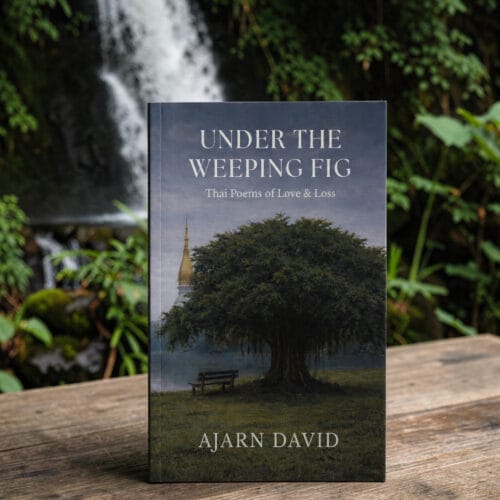
Under the Weeping Fig is written in both Thai and English.
The Thai Poet & His Place
A
quick word about the man behind the poems. Ajarn David is a university lecturer, most recently at Rajabhat University in Sakon Nakhon, living on a farm in the northeast of Thailand — Isaan — with his Thai wife and daughters.
He is, by his own description, a farang who will never fully become Thai, and yet whose life is irrevocably bound to Thailand and the people who inhabit it. This dual identity — insider and outsider simultaneously — is itself a form of perpetual separation, and it gives his poetry a particular quality of longing that cuts across cultures.
Poem #90 of Poems from Sakon Nakhon addresses this directly through a conversation with another foreigner who insists that no matter how many years one spends in Thailand, one can never fully become Thai. Yet the poem ultimately reframes this distance as a kind of advantage: the outsider, standing slightly apart from the culture around him (like a monk on a mountaintop), may gain a clearer perspective on what truly matters in life.
It’s a classic Nirat conceit: the outsider, separated from the world around him, gains a vantage that the insider cannot have. The farang on the mountaintop is, like the traveling poet of the Nirat tradition, granted a peculiar kind of insight by his very displacement.
Nirat & The Poet's Journey
T
he Nirat is a genre characterized by the themes of journeying, separation, and love-longing.
In the classical Nirat tradition, the journey is typically physical — the poet travels to a temple, into exile, or across the country — and the landscapes he passes through become mirrors of his emotional state. In Lam Nam Phu Kradung, Angkhan travels to the Phu Kradung plateau; Naowarat circles the entire country for Khian Phandin; Paiwarin's Banana Tree Horse is structured around the movement of Isaan people from their villages to Bangkok in search of a better life — a collective migration that the poet witnesses and mourns rather than a single physical journey of his own.
Ajarn David's journey is both physical and metaphysical. Poems from Sakon Nakhon is rooted in the landscape of northeast Thailand — the monsoon rains, the flooded rice fields, the mountain mists, the indigo hues of the countryside — while Under the Weeping Fig represents a movement inward, increasingly concentrated on the interior landscape of love, loss, and longing.
The journey from the first book to the second mimics the arc of many classical Nirat: the poet moves from celebration of place to lamentation of absence. The opening of Poems from Sakon Nakhon is almost deliberately Nirat-like in its grounding of the collection in place, time, and natural observation:
"When the rains come / to Sakon Nakhon, / a new world /springs to life. / Waterfalls appear / in the mountains, / streams rise / in old ditches and canals, / fish splash / in the flooded fields, / as if dropped like mana / from the sky..."
This is the landscape that begins the classical Nirat — the vivid, inhabited world of the poet's origin, described with richness and particularity before the lamentation takes hold.
Throughout both books, Isaan is never merely backdrop. It is, as Naowarat said of Thailand in Khian Phandin, the "foundation" from which everything else grows. Sakon Nakhon is not a setting but a subject — loved, observed, written into permanence.
Separation from the Beloved
T he central engine of the Nirat is separation from the beloved, and here Ajarn David's poetry is unambiguously in the tradition.
What distinguishes his version of the separation is its tonal honesty — the beloved is not idealized in the way of classical Nirat, but observed with tenderness, frustration, humor, and a kind of lucid sorrow.
Under the Weeping Fig is devoted almost entirely to a single arc of feeling: loving someone who cannot or will not return that love fully. This is the classic Nirat situation rendered in free verse, stripped of ornamental formality but not of emotional precision.
The Thai language even supplies Ajarn David with a more exact vocabulary for his predicament — Poem #6 of Under the Weeping Fig contrasts the English "unrequited love" with the Thai rák kâang dio, "one-sided love," and finds the Thai more honest: The Thai is better, less needy, more like love itself, which is always one-sided and asks nothing in return.
This is the spirit of the Nirat lamentation rendered with contemporary directness. The classical Nirat poet would have adorned this same sentiment with elaborate metaphors and formal versification; Ajarn David compresses it into twelve words. The ache is the same.
The separation is never clean or simple. Poem #30 of Poems from Sakon Nakhon captures the involuntary nature of longing through the image of a man sitting quietly, only to find thoughts of the beloved intruding against his will, turning what should have been a peaceful moment into one overshadowed by memory and emotional disturbance.
And later, Poem #35 of Under the Weeping Fig reveals the poet's ambivalence about resolution itself — as though the fever of longing, unwelcome as it is, has become the only confirmation of feeling alive. The poem suggests that if the beloved ever fully understood the depth of his feelings, something essential in the emotional tension between them might disappear, breaking the spell that has sustained the longing itself.
This is a subtly unusual stance — the poet does not desire resolution because resolution would extinguish the love. It recalls the paradox at the heart of Paiwarin's Banana Tree Horse, where the lamentation of lost Isaan culture is itself described as "hopeful" because as long as the longing lives, so does the thing longed for.
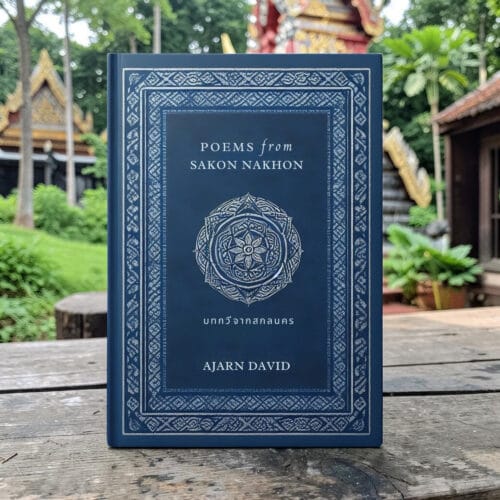
Poems from Sakon Nakhon features 92 bilingual Thai-English poems.
The Act of Writing as Solace
T
he most direct statement of Ajarn David's Nirat sensibility appears in Poem #67 of Poems from Sakon Nakhon, which functions as a kind of ars poetica for both books.
Rather than surrendering to the despair of unattainable love, the poem proposes that longing can be redirected into the creation of something meaningful and enduring. The emotional energy that might otherwise lead only to isolation or self-pity becomes, instead, the force that gives rise to art itself.
This is the philosophical spine of both collections. The poet acknowledges the futility of the love and then refuses futility as a response. He transforms the energy of longing into the act of creation — the poems themselves.
This is, in microcosm, exactly what Angkhan Kalayanapong did in Lam Nam Phu Kradung: lamenting that he was too poor to find any true love, he directed that longing toward nature instead, and in doing so created some of the most celebrated Thai poetry of the twentieth century.
Ajarn David performs the same transformation, though the scale is different and the terrain more intimate.
In this sense, Poems from Sakon Nakhon and Under the Weeping Fig are not merely books about love and separation — they are the act of redirection that Poem #67 prescribes.
The collections, taken as a whole, embody their own central argument. The Nirat tradition can be regarded as a "travel diary" filled with artistic expression of emotions, reflections on past experiences, and observations on surroundings.
What Ajarn David adds to this is the explicit awareness of the diary-as-consolation. The writing is not incidental to the journey; it is the journey.
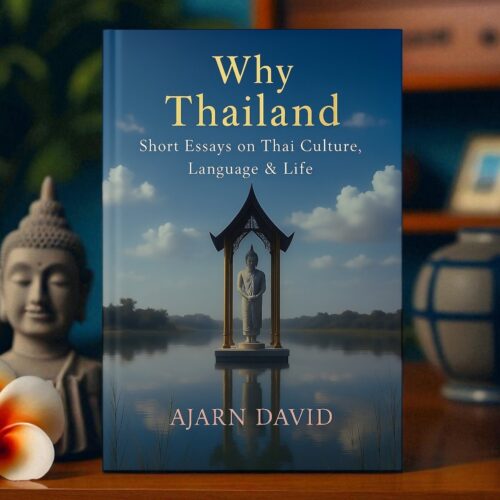
Ajarn David also has written a book on Thai culture and language.
Love of Place: The Isaan Poems
O
ne of the ways Ajarn David's work aligns most closely with the modern Nirat tradition — particularly with Naowarat's Khian Phandin and Paiwarin's Banana Tree Horse — is in its love for a specific region and its culture. For Ajarn David, that region is Isaan, and specifically Sakon Nakhon.
Like Naowarat, who wished to "preserve" the beauty of his homeland in verse before it disappeared, Ajarn David documents Sakon Nakhon with the attentiveness of someone who knows how quickly things change.
The rice varieties of Hawm Dawk Hung, the indigo hues of the countryside, the khaen music, the wai khru ceremony, the temple drums heard in the distance — these are recorded with the care of a man who takes nothing for granted:
When I think / of Sakon Nakhon, / I think of Indigo, / with its beautiful blue /and purplish hues, / mystic colors / that stir the soul / from its sleep... (Poem #34, Poems from Sakon Nakhon)
And like Paiwarin, who lamented the erosion of Isaan's traditional values in the face of Bangkok-driven modernization, Ajarn David is alert to cultural loss, though his tone tends toward gentle elegy rather than anguish.
The legendary Isaan monk Ajarn Mun, who spent fifty years in the forests before returning to the city to die — specifically to protect those forests from the footsteps of mourners — is memorialized in Poem #76, one of the most quietly moving poems in either collection. And it's the same impulse that animates Naowarat's Khian Phandin — the desire to protect beauty by bearing witness to it, to preserve in language what the world may erase.
Buddhism, Karma, and the Journey Toward Equanimity
T
he classical Nirat and Buddhism were always close companions.
Many Nirat were written during pilgrimages to temples or shrines, and the great poets of the tradition drew freely on Buddhist concepts — karma, impermanence, the consolations of detachment — as both subject and emotional vocabulary.
Buddhist themes run throughout both of Ajarn David's collections, though the approach is that of a thoughtful student rather than a practitioner — curious, respectful, often finding in Buddhist concepts an unexpected precision for describing human experience.
Poem #5 of Poems from Sakon Nakhon takes the First Noble Truth — all life is suffering — and finds in it not resignation but a kind of floral beauty, where we are called upon to take up our suffering "like the stem of a flower."
Poem #81 follows a woman to the edge of Buddhist emptiness, only to find that the void is where joy begins. Poem #3 transforms the Thai joke of chaat naa bai bai — "the next life" — into a genuine consolation when the years have accumulated enough weight.
The most explicitly pilgrimage-like poem in either collection is Poem #19 of Poems from Sakon Nakhon, centers on Khao Phansa, the Buddhist rains retreat. The poem begins by describing the traditional monastic practice of withdrawing from ordinary movement and activity during the rainy season for contemplation and meditation, before turning inward and reimagining that retreat as something accessible to anyone.
Rather than emphasizing ritual observance alone, the poem suggests that even a few moments each day spent withdrawing from worldly concerns in search of clarity and stillness can become a kind of personal retreat.
This inward movement places the poem firmly within the spiritual dimension of the Nirat tradition, where physical journeys often parallel the search for inner understanding and emotional balance.
Buddhist themes continue throughout Under the Weeping Fig as well — appearing not only in explicit references to the Buddha, karma, impermanence, and spiritual stillness, but also in the collection’s recurring movement toward acceptance, non-attachment, compassion, and gratitude. These ideas ultimately culminate in the forest epilogue that closes the book.
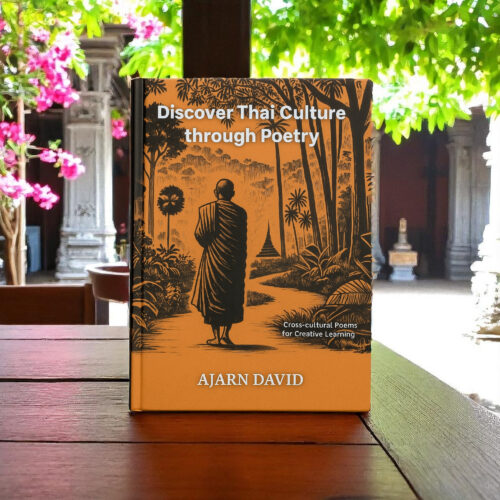
Ajarn David also has written a poetry textbook to teach Thai culture.
The Difference: A Nirat Without Formal Convention
T
here are significant ways in which Ajarn David's work differs from the Nirat tradition, and these differences are worth acknowledging directly.
The classical Nirat is formally regulated — composed in strict Thai metrical forms such as khlong, klon, and kap, among others, requiring precise syllable counts, tonal patterns, and rhyme schemes.
Ajarn David writes entirely in free verse, in both English and Thai. He addresses this directly in his preface to Under the Weeping Fig, where he states his respect for traditional Thai poetic forms while explaining his preference for free verse as better suited to both his temperament and the emotional immediacy he seeks.
The bilingual nature of both collections is also entirely without classical precedent. The traditional Nirat poet wrote in one language for one audience. Ajarn David writes in two languages simultaneously — or nearly so — with the Thai and English versions described in Under the Weeping Fig as "two parallel expressions of the same experience, each shaped by the unique nature of its language."
This parallel composition is a genuine innovation, creating a text that exists in two registers at once, each complete in itself, each enriched by the existence of the other.
There is also no single, sustained physical journey in these collections. The classical Nirat follows a route — from city to shrine, from capital to exile — and the places named along the way provide the structural spine of the poem.
Ajarn David's journey is a life lived in one region over many years, punctuated by reflection rather than movement. The "journey" is interior and temporal rather than geographical. But the spirit is unmistakably the same.
At its core, Nirat is poetry of journey and separation — works traditionally composed around travel, shaped by longing for an absent beloved, whether that separation is literal, imagined, emotional, or symbolic.
Ajarn David’s separation is geographic, cultural, and emotional simultaneously, and his expression of that longing unfolds across ninety-one poems in the first collection and seventy-two in the second.
The Culmination: Five Days in the Forest
T
he most remarkable convergence between Ajarn David's work and the Nirat tradition occurs not in any single poem, but in the epilogue that closes Under the Weeping Fig.
There’s something fitting about a poet who writes about longing and loss ending his book with a retreat into the forest. The great Nirat poets often framed their journeys in explicitly spiritual terms — the physical journey to the temple paralleling the inner journey toward understanding — and Ajarn David’s five days in the Phu Phan mountains sit squarely in that tradition.
Ajarn David, having completed his book of poems about love and loss, retreated into the forests of the Phu Phan mountains for a five-day fast. His account of this retreat reads like the culmination of everything the two books have been building toward.
Staying in a small kuti near Phu Pha Yon National Park, meditating during the fast, he experiences a dream that leads him deeper into the forest, where he encounters an old tree whose presence feels almost animate — ancient, watchful, and strangely aware.
What follows is presented not quite as fantasy, nor entirely as metaphor, but as a moment of spiritual encounter that brings the emotional journey of the two books quietly to rest. This is, in its strange and beautiful way, the resolution that the classical Nirat seeks.
The poet has traveled — through two books, through years in Isaan, through the geography of unrequited love — and arrived at the place where lamentation is no longer necessary.
The epilogue does not resolve longing through reciprocation or fulfillment, but through a widening of perspective that transforms suffering into gratitude.
The classical Nirat often ends at a place of worship — a temple, a shrine — where the poet makes offerings and receives, if not resolution, at least the comfort of something larger than himself.
Ajarn David's ending is unmistakably in this spirit: he goes to the forest — the oldest temple — and there receives his answer.
The epilogue also echoes the resolution that Angkhan Kalayanapong sought in Lam Nam Phu Kradung, ending his Nirat with a prayer to forever love the Earth and Sky. Both poets, separated from personal love, ultimately arrive at a deeper relationship with the living world itself.