"Mai Rak Mae Kha" works on a small scale — a man, a woman, a noodle shop near a bus stop, a daily ritual — but it leans on the same device Thai and American songwriter storytellers use. Instead of telling us the man is lonely or secretly in love, it lets what he does tell us.
S
ome songs describe a feeling. "Mai Rak Mae Kha" (ไม่รักแม่ค้า) does something different: it tells a story, with a character, a setting, and an ending the listener has to earn.
One of four songs on Ajarn David's "Ysaan" EP, it follows a man who visits the same noodle shop every day and insists he's there for the food, not the woman who runs it. He only understands what was really bringing him back once the shop closes for good.
The song's lineage runs in two directions at once. Its tight, punchline-driven narrative owes something to the North American singer-songwriters of the 1970s; its setting and humor belong to Thailand's own long habit of turning ordinary lives into song.
Ajarn David, who has lived in Thailand for 24 years, grew up on storyteller-songwriters like Jim Croce and Harry Chapin, and their way of building a song around a character caught in a small revelation shaped how he wrote this one.
The North American Story-Song Tradition
J
im Croce, Harry Chapin, and Gordon Lightfoot wrote songs that worked almost like short stories, populated by taxi drivers, telephone callers, and people looking back on choices they could no longer change.
What Ajarn David absorbed from them, above all, was a preference for showing a person inside a situation rather than announcing what that person feels.
"Mai Rak Mae Kha" doesn't open with a declaration of love — it opens with a man sitting alone at a familiar shop while his friends notice something about him he hasn't admitted to himself yet.
Croce's "Operator (That's Not the Way It Feels)" is built from one side of a payphone conversation: a man asks an operator to connect him to a former lover, insisting he only wants to prove he's doing fine. The longer he talks, the more that claim falls apart — the phone call itself becomes the evidence against him.
Chapin's "Taxi" works the same way from a different angle. A cab driver picks up a passenger and realizes she's a woman he loved years earlier; the ride across the city becomes a ride through everything they once imagined for themselves.
Chapin never explains what the song means. He puts two people in a cab and lets what they say and don't say do the work.
Lightfoot, a Canadian working in that broader North American folk tradition, could scale the same technique up considerably.
"The Wreck of the Edmund Fitzgerald" turns a maritime disaster into narrative; "Canadian Railroad Trilogy" turns the building of a railway into a story about ambition and sacrifice.
Whether the subject was a private memory or a historical event, Lightfoot trusted concrete detail to pull a listener in rather than explain a song to them.
"Mai Rak Mae Kha" works on a far smaller scale — a man, a woman, a noodle shop near a bus stop, a daily ritual — but it leans on the same trick. Instead of telling us the man is lonely or secretly in love, it lets what he does tell us.
Here the road leads back.
Storytelling in Thai Song
N arrative songwriting isn't foreign to Thailand at all — it's been central to luk thung, mor lam, and phleng phuea chiwit for generations.
Luk thung grew up alongside rural and working-class life, and its songs have long carried the experiences of farmers, laborers, migrants, and people trying to build lives far from home.
Ethnomusicologist James Mitchell describes the genre as one that has given voice to the aspirations, frustrations, and hardships of ordinary Thai people, while staying open to outside musical influence without losing its Thai footing.
Some of these narrative songs unfold through one voice; others split into a call and response between two characters. "Num Na Khao Sao Na Kluea" (หนุ่มนาข้าว สาวนาเกลือ), written by Soraphet Phinyo and originally recorded with Nongnut Duangchiwan in 1982, pairs a rice farmer and a salt farmer and turns their different working lives into a romance.
"Chanthana Thi Rak" (จันทนาที่รัก) and its answer song, "Chanthana Top Rak" (จันทนาตอบรัก), build a relationship across two separate recordings rooted in the lives of factory workers. These are not abstract love songs; their characters inhabit recognizable social worlds shaped by work and place.
All three songs have been studied as records of migration, labor, and belonging during Thailand's industrial transformation.
Phleng phuea chiwit takes the same instinct somewhere else. Artists like Caravan and Carabao have used individual lives to open onto bigger questions — poverty, migration, inequality.
The scale is different from "Mai Rak Mae Kha," but the premise is the same one Ajarn David is working from: an ordinary person's life can hold a story worth singing.
A Close Relative: "Mae Kha Ta Khom"
The song's closest relative may be the classic luk thung number "Mae Kha Ta Khom" (แม่ค้าตาคม), "The Sharp-Eyed Vendor," written by the celebrated songwriter Paiboon Butkhan and recorded by Sornkhiri Sriprachuap around 1970–71.
That earlier song is a playful account of a man drawn to a woman selling food in a market, where his interest in her and his interest in her cooking are openly tangled together.
More than fifty years later, "Mai Rak Mae Kha" returns to the same setup — a male customer, an appealing vendor, romance disguised as appetite — but tells it differently.
In the older song, the attraction is celebrated outright. In "Mai Rak Mae Kha," the joke runs on denial: his friends see exactly what he won't admit.
He insists he loves the red pork noodles and the crispy pork noodles, but not the vendor — ไม่รักแม่ค้า รักบะหมี่หมูแดง รักบะหมี่หมูกรอบ แต่ไม่รักแม่ค้า ไม่รักจริงๆ
Every day he leaves at noon, drives to the shop, and parks right in front so she'll see him arrive.
His words say one thing; his behavior says another, and the chorus keeps making sure we notice the gap.
Noodle Shops in Ajarn David's Poetry
T
he noodle shop isn't a setting invented just for this song.
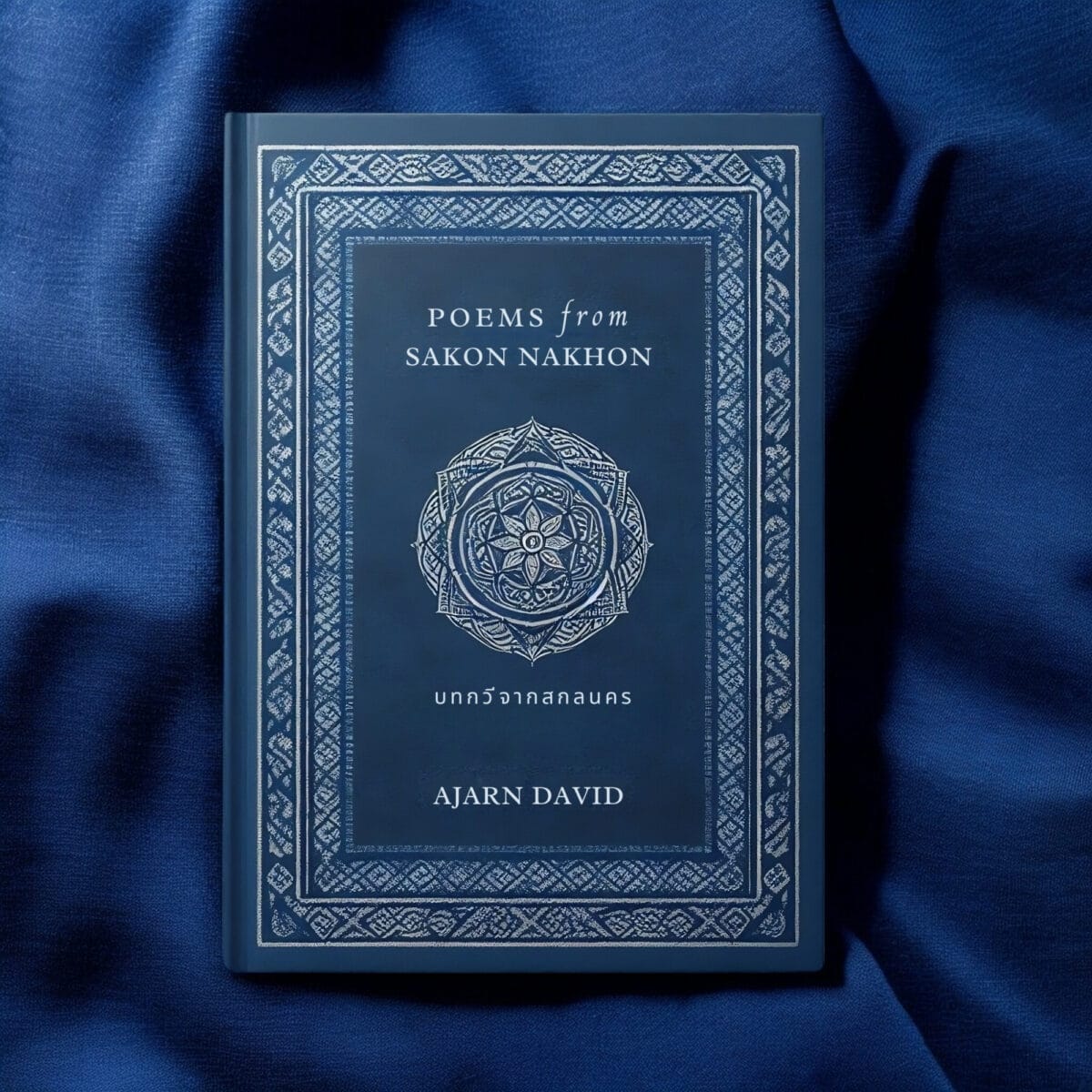
It turns up repeatedly across Ajarn David's two bilingual poetry collections, Under the Weeping Fig and Poems from Sakon Nakhon, where it becomes a place where ordinary hunger, loneliness, and hope happen to overlap.
Poem #11 in Under the Weeping Fig describes a man's unspoken love for a woman he never touches — no kiss, no hug, not even a held hand. He's content to wait for their paths to cross once or twice a week, sometimes at a noodle shop, and the poem's restraint does the emotional work: nothing dramatic happens, yet the chance of seeing her shapes his days.
Poem #28 comes even closer to "Mai Rak Mae Kha." A man asks a vendor why her noodles taste so good; she answers, "Love." So he keeps coming back for bami moo daeng and chaa manao, taking whatever portion of that love he can get. Food becomes an indirect way of naming an affection he can't fully have.
In poem #6 from Poems from Sakon Nakhon, a noodle seller working after dark becomes "an angel in disguise," her bowls of guaitio nam tok and guaitio nam sai described as "30 baht blessings" for people heading home alone, still waiting to find a fan.
The shop offers more than a meal — warmth, company, a small refuge from being by yourself.
What "Mai Rak Mae Kha" does with this recurring setting is give it a full arc. Unlike the men in the poems, this customer eventually loses the place — and the woman — before he understands what those visits actually meant.
A Thai Song in Three Scenes
The song plays out almost like a short film. In the first scene, the man sits alone while his friends tease him: he's ตกหลุมรัก, fallen into love and can't climb back out.
In the second, the routine sharpens — same time every day, the same spot to park where she'll see him. He isn't just there for lunch; he wants to be seen arriving.
The third scene breaks the pattern: he comes back to find the shop closed, a goodbye sign where the noodle stand used to be, and for the first time he has to separate the food from the person who served it.
The chorus flips: รักมากแม่ค้า ไม่บะหมี่หมูแดง ไม่บะหมี่หมูกรอบ แต่รักมากแม่ค้า รักมากจริงๆ
Same words, opposite meaning. What sounded like a joke about a man who loved noodles turns out to have been a song about someone who recognized love only after it was gone.
A Bilingual Story Song
"Mai Rak Mae Kha" doesn't copy either tradition — it runs them side by side. The English verses carry the narration: the shop, the daily visits, the closing sign.
The Thai chorus carries the denial, then the confession. English tells us what happened; Thai gives us the words he uses to hide it, and later to admit it.
What comes out of that combination is a bilingual pop song with the shape of a short story and the setting of an ordinary Thai memory — Croce and Chapin's trick of letting behavior expose a truth someone can't yet say out loud, applied to the kind of small, funny, working-life scene Thai luk thung songwriters have been writing for decades.
There's nothing grand about a noodle shop near a bus stop. That's the point: some places only matter once you find out you can't go back to them, and sometimes what you thought you came for wasn't the reason you kept showing up.