Through English-teaching videos for Thai audiences, cultural explanations for foreigners, and bilingual poetry and music for both, Ajarn David has developed a visible role as a promoter of Thai language, culture, Isaan, and the texture of authentic Thai life.
Four Songs, Five Recordings, One Continuing Project
A
jarn David's move from poetry into songwriting looks, at first glance, like a change of direction.
His books established him as a bilingual writer working through Thai language, rural Isaan life, Buddhism, love, and loss.
His songs place those same concerns inside melody, chorus, and dialogue between male and female voices. But the music isn't a departure from the books — it's their continuation in a different register, reaching audiences beyond poetry readers through melody and repetition.
Across four original songs and five recordings, he returns to two landscapes that already organize his writing. One is the physical geography of Sakon Nakhon: the Phu Phan mountains, Nong Han lake, temples, rice fields, indigo cloth, and the food stalls and daily errands of the people who live among them.
The other is an interior landscape of longing, hesitation, infidelity, and humor — feelings that resist being said plainly.
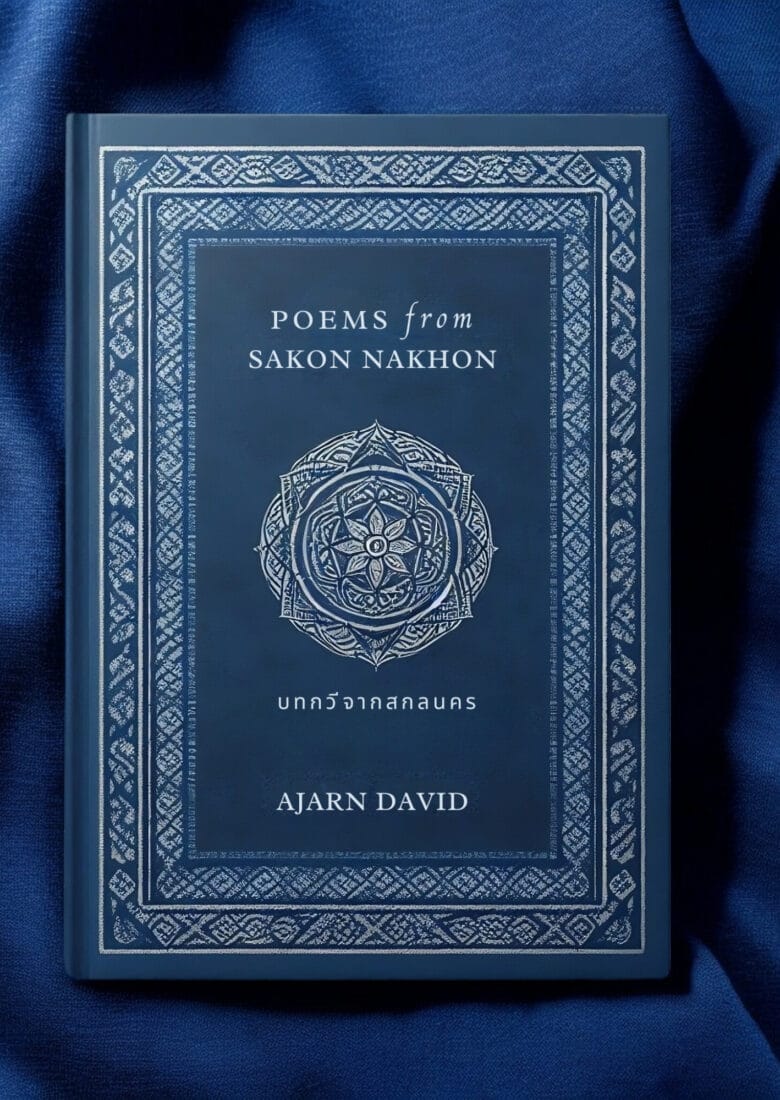
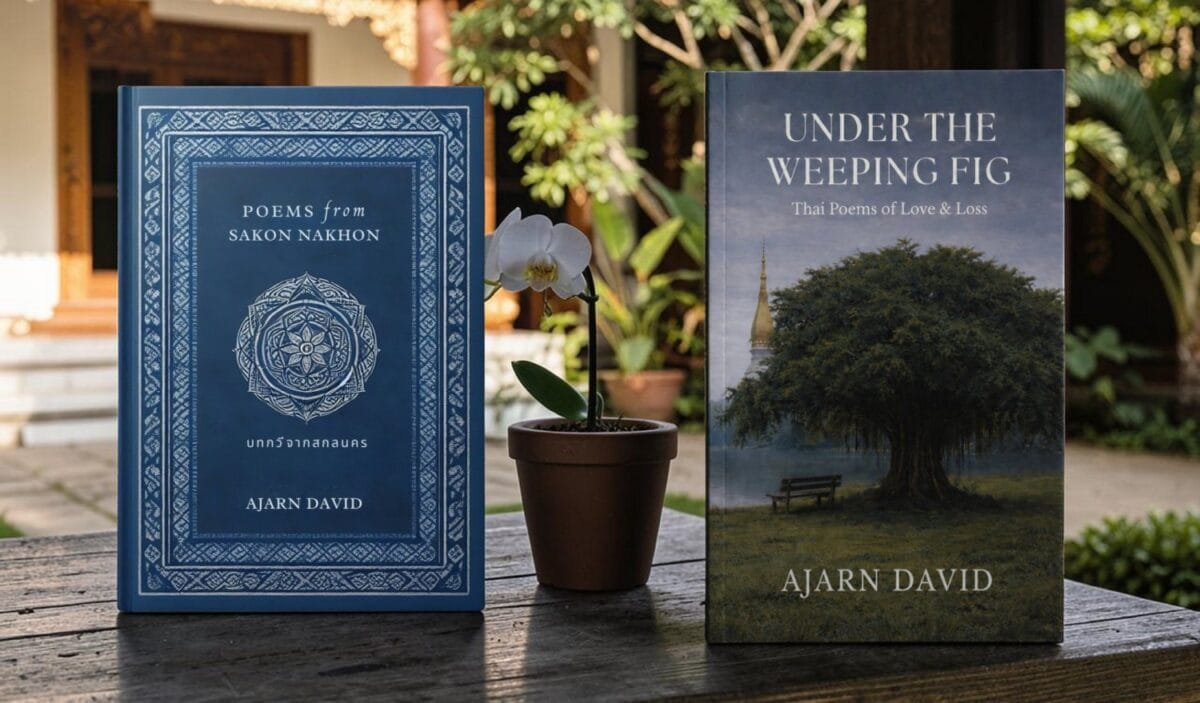
Those two landscapes track his two poetry collections. Poems from Sakon Nakhon (2025) looks outward toward place and everyday Isaan experience. Under the Weeping Fig: Thai Poems of Love & Loss (2026) turns inward toward love, separation, and acceptance.
A third book, the bilingual self-help volume Life Lessons from Isaan — translated from a Thai original, เมล็ดใจบาน (A Seed Blooms in the Heart), which he first wrote as a gift to his students — adds a more direct register: short reflections on forgiveness, gratitude, and purpose, illustrated with Thai drawings.
His essay collection Why Thailand supplies a fourth angle, examining the social and linguistic patterns beneath the surface of Thai life.
The songs pull threads from all of these. "Rak Sakon Nakhon" (รักสกลนคร) turns the province itself into the object of a love song. "Kit Teung Teu" (คิดถึงเธอ) places romantic uncertainty between Thai and English. "Mai Rak Lai Jai" (ไม่รัก หลายใจ), recorded in a male acoustic version and a female piano version, lets two voices confront unfaithfulness from different emotional positions.
"Mai Rak Mae Kha" (ไม่รักแม่ค้า) turns a noodle shop and a running joke into a story about love recognized too late.
The Writer Before the Songs
Ajarn David is an American writer and university lecturer who has lived in Thailand since 2002. He attended graduate school in North Carolina, where his first two poetry collections were published, then spent time lecturing at the University of West Bohemia in the Czech Republic before settling in Sakon Nakhon.
He now teaches at Sakon Nakhon Rajabhat University, has a Thai wife and two Thai daughters, and publishes through Ysaan Books, an independent press based in the province.
That trajectory matters because the work depends on duration rather than discovery. This isn't a Thailand encountered for the first time; it's the Thailand that emerges once novelty has worn off, when temples become places of ordinary practice and Thai words start carrying meanings their English equivalents can't quite hold.
His public work has extended beyond books and classrooms to language-teaching videos on TikTok and now music. Poetry gave him compression and image. The essays gave him context. Teaching gave him an ear for what Thai and English do differently.
Music let all of that become something people could repeat and sing together.
Poems from Sakon Nakhon: The Outward Landscape
P
oems from Sakon Nakhon contains 91 poems in English and Thai, with romanized transliteration to help readers approach the language.
It builds its portrait of northeastern Thailand from accumulated particulars — monsoon weather, rice fields, temples, food, humor — rather than general claims about the region.
An essay examining Ajarn David's poetry in relation to the modern nirat tradition places the collection within Thailand's long association of journey, landscape, and longing, while noting that the poems work entirely in free verse rather than the meter governing classical forms.
A separate discussion of his relationship to Thai poetic tradition considers his unadorned, conversational style beside the work of canonical Thai poets.
"Rak Sakon Nakhon" and "Mai Rak Mae Kha" work the same way. A listener comes to understand Sakon Nakhon through Phu Phan, indigo cloth, Nong Han, a waterfall, mushroom hunting, merit-making, and a bowl of noodles — not through praise, but through the accumulation of specific, named things.
Under the Weeping Fig: The Inward Landscape
Under the Weeping Fig (2026) contains 72 bilingual poems and turns the same clear-eyed attention inward, toward love, memory, and grief.
The landscape doesn't disappear — roads, temple grounds, and the Phu Phan forest remain the settings — but the subject shifts to Thai concepts of trust, restraint, and non-attachment.
One sustained reading treats the collection's poems as variations on unrequited love: not melodrama, but an attempt to understand affection without possession, in which the beloved stays autonomous and longing is sometimes painful, sometimes absurd, sometimes enough in itself.
Where the first collection maps an external world, this one maps what David called, in an interview, the small moments that reveal the most about people — here turned toward the interior.
"Kit Teung Teu" and "Mai Rak Lai Jai" come directly out of this territory: one circles a confession neither singer can quite make, the other begins after the circling has ended.
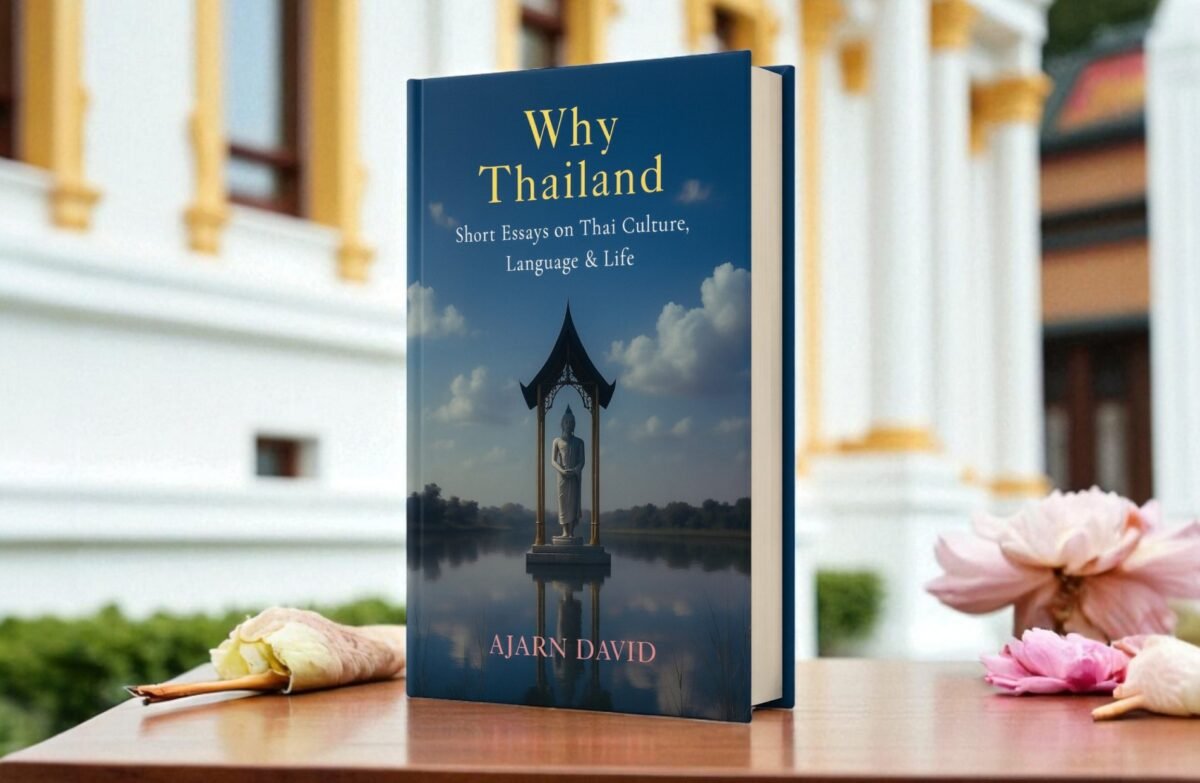
Why Thailand is a collection of 75 essays by Ajarn David.
Why Thailand and Life Lessons from Isaan
W
hy Thailand takes up many of the same subjects in short prose essays, asking not just what happens in Thailand but why — saving face, merit-making, spiritual etiquette, and the cultural weight carried inside ordinary expressions.
It is less concerned with cataloguing customs than with revealing the social logic connecting them: how politeness protects relationships, why indirectness can convey consideration rather than evasion, and how Buddhist values continue to shape apparently secular routines.
Life Lessons from Isaan approaches similar territory more directly, distilling Buddhist principles — forgiveness, gratitude, karma — into short reflections originally written in Thai for his own students before being translated back into English.
Both books provide the cultural ground beneath what the songs do without pausing to explain: "Kit Teung Teu" turns an emotional problem into a language problem. "Mai Rak Mae Kha" turns a Thai idiom into the hinge of a joke and a romance.
"Rak Sakon Nakhon" works through meuang saam tham (เมืองสามธรรม) and merit-making. "Mai Rak Lai Jai" depends on the force of lai jai (หลายใจ) — literally "many-hearted," a different image of unfaithfulness than the English word "cheating" gives us.
The essays in Why Thailand explain such differences directly; the songs let listeners feel them in context.
"Rak Sakon Nakhon": A Province as the Beloved
T
his song sits closest to Poems from Sakon Nakhon. Its duet structure creates a shared journey, with the male and female singers alternating invitations:
Let's ride through the Mountains of Phu Phan (ภูพาน)
Let's go shopping for phaa see khraam (ผ้าสีคราม)
Let's sit by the waters of Nong Han (หนองหาร)
Let's go home to meuang saam tham (เมืองสามธรรม)
The phrase meuang saam tham names Sakon Nakhon as the "City of Three Dharmas": thamma (ธรรมะ, spiritual life), thammachat (ธรรมชาติ, nature), and watthanatham (วัฒนธรรม, culture).
The verses that follow make that identity concrete: Phra That Phu Phek and its Khmer past, a wai to the revered forest meditation teacher Ajarn Fan at Wat Tham Kham, Preecha Suksan waterfall, hunting hed phor mushrooms at Phu Pha Yon, the Christmas stars of Ban Tha Rae's Catholic community, merit-making with parents, and eating Phon Yang Kham steak and som tam by a pond.
The chorus gathers all of it into a single refrain: Sakon Nakhon, glai teung baan (สกลนคร ใกล้ถึงบ้าน) Khit teung jang cheewit chao-ban (คิดถึงจัง ชีวิตชาวบ้าน) Rak Isaan, thung na suay ngam (รักอีสาน ทุ่งนาสวยงาม) Rak Sakon, glai teung baan (รักสกล ใกล้ถึงบ้าน).
Glai teung ban — "almost home" — keeps the song moving rather than static: the singers are traveling through the province, watching home draw closer through recognizable places. It's a small inversion of the nirat tradition, which usually travels away from home and mourns the distance.
In "Rak Sakon Nakhon" the road leads back.
"Kit Teung Teu": Longing Between Two Languages
A Thai-English duet about two people who seem to feel the same thing but can't say it at the same speed.
The male voice opens in English, self-conscious about speaking English:
Why do you make it so hard for me To say the things I want us to be, You love your English, it's oh, so cool, But when I try, I sound like a fool.
The female voice answers with mock exasperation — O phrajao loei (โอ้พระเจ้าเลย), "oh my God, here we go again" — before admitting later that she finds expression just as hard.
The chorus is built almost entirely from kit teung teu (คิดถึงเธอ), "I miss you," and roo mai wa (รู้ไหมว่า), "do you know that?"
Repetition changes its register across the song: teasing at first, more sincere by the final chorus, with no confession arriving to resolve things cleanly.
That patience — refusing to force a conventional resolution — is very much in the spirit of Under the Weeping Fig.
The bilingual structure does real work here. English isn't just the language used to explain the story to outsiders; inside the story, it's the language that makes the male character feel foolish, while Thai carries the emotional weight of the chorus.
Translation gets you into the song, but the Thai phrase is what stays with you.
"Mai Rak Lai Jai": Two Perspectives on Betrayal
T
he most direct breakup song of the four. Its title suggests "Don't Love an Unfaithful Heart," though lai jai literally means "many-hearted" — giving affection to more than one person.
The lyrics begin after the decision has already been made:
This is the end,
there's nothing left for us to mend,
nothing left now to pretend.
Don't try again.
Mai rak… lai jai (ไม่รัก… หลายใจ)
Jop wan-nee (จบวันนี้)
Mai rak… lai jai (ไม่รัก… หลายใจ)
Pai sa-tee (ไปซะที)
The song exists in two recordings with identical lyrics: an acoustic version sung by a man, and a piano version sung by a woman.
In the male version, the stripped-back guitar makes the declaration sound exposed, like someone recovering his dignity after having pleaded once already — a history made explicit in the second verse (There was a time / when I'd beg you not to walk away. / Today is not that day.).
In the piano version, the same line — sung by a woman — reads differently: less like recovered dignity, more like the moment patience stops being mistaken for weakness.
Read against Under the Weeping Fig, this is less a contradiction of the collection's interest in love without possession than a boundary on it: non-attachment doesn't require tolerating betrayal.
And the closing line, Go love again, lands somewhere between dismissal and release — the singer no longer trying to control where the other person's heart goes next.
"Mai Rak Mae Kha": Humor, Denial, and Love
T
he most comic of the four songs, built on a familiar pattern: people often understand what an ordinary presence meant only after it's gone.
A man visits the same small food shop near a bus stop every day; his friends tease him for having dtok lum rak (ตกหลุมรัก), "fallen in love."
He denies it through the chorus — he loves the red pork noodles, the crispy pork noodles, not the shopkeeper — while the details quietly contradict him: he leaves at noon every day, parks where she'll see him, wants to hear her say yin-dee dtawn-rap (ยินดีต้อนรับ), "welcome."
Then the shop closes, and the chorus flips:
Rak maak mae kha (รักมากแม่ค้า)
Mai bamee moo daeng (ไม่บะหมี่หมูแดง)
Mai bamee moo grawp (ไม่บะหมี่หมูกรอบ)
Dtae rak maak mae kha (แต่รักมากแม่ค้า)
Rak maak jing jing (รักมากจริงๆ)
The joke rests on a literalized idiom — "falling into the hole of love," extended in the English lyric to "couldn't get up" — that Thai listeners will recognize instantly and English listeners get to discover.
The unnamed shopkeeper, mae kha (แม่ค้า), is never made exotic; she's simply a woman running a shop, and the man's elaborate denial is the joke, not her.

Male and Female Thai Voices
T
hree of the four Thai love songs depend directly on the exchange between male and female perspectives:
"Rak Sakon Nakhon" alternates invitations, "Kit Teung Teu" turns a misunderstanding into a duet, and the two recordings of "Mai Rak Lai Jai" put identical words in different mouths to show how the same lyric can mean something different depending on who's singing it.
Even "Mai Rak Mae Kha," uses a female voice to tell the story of a man whose daily visits depend on the quiet presence of the shopkeeper he refuses to admit he loves.
This isn't incidental. Bilingual writing already requires holding two versions of a thing in parallel — a Thai line and its English counterpart are never exact duplicates, each carrying its own rhythm and shading.
The male and female recordings of "Mai Rak Lai Jai" extend that same principle into performance: neither version cancels the other, and the truth of the song sits in the gap between them.
A Few Phrases That Carry the Whole Method
The songs compress David's larger bilingual project into single lines that listeners absorb as feeling before they absorb as vocabulary:
• Kit teung teu (คิดถึงเธอ) — softer and more sustained than "I miss you."
• Lai jai (หลายใจ) — infidelity imagined as a heart divided among several people, rather than a broken rule.
• Dtok loom rak (ตกหลุมรัก) — "falling in love" as a literal, comic image of a hole.
• Glai theung baan (ใกล้ถึงบ้าน) — home as something felt approaching, not simply arrived at.
Because these phrases are sung and repeated rather than defined, they land as structures of feeling first — which is, in miniature, the same bet the essay collection makes about language and culture more broadly.

Promoting Thai Culture Through Everyday Life
T
he bilingual Thai poetry books and songs sit within a larger public project.
Through English-teaching videos for Thai audiences, cultural explanations for foreigners, and music for both, Ajarn David has developed a visible role as a promoter of Thai language, culture, Isaan, and the texture of ordinary Thai life.
The continuity across those forms matters: the lecturer, poet, essayist, language teacher, and songwriter are not separate public identities. Each offers another way of bringing Thai and international audiences into the same conversation.
His teaching videos on TikTok frequently begin with situations Thai viewers actually encounter — speaking with customers, working in restaurants, explaining a feeling, or choosing a natural English phrase — rather than abstract grammar detached from daily use.
At the same time, his Thai-language explanations show international observers that Thai is not simply a code to be converted word for word into English.
Tone, relationship, indirectness, humor, and social context all affect what an expression means.
The emphasis on Sakon Nakhon is equally important. International images of Thailand remain dominated by Bangkok, beaches, nightlife, and a limited group of famous destinations.
Ajarn David's work repeatedly redirects attention toward northeastern Thailand: university classrooms, village shops, family merit-making, rice fields, forest temples, regional food, indigo craft, and roads through the Phu Phan mountains.
Ysaan Books makes that regional commitment explicit in its mission to promote the arts, culture, and people of Northeast Thailand.
This is what “authentic Thai life” means within his work—not a claim that one Thailand is more legitimate than every other, but a commitment to showing life at its actual scale.
A shopkeeper saying welcome, parents making merit, someone eating som tam beside a pond, or a speaker struggling to express affection can reveal as much about a culture as a monument or national festival. That perspective also distinguishes promotion from simple praise.
Why Thailand acknowledges the misunderstandings and tensions that can arise between Thai and foreign expectations; the love poems allow uncertainty, betrayal, and grief; the teaching videos address real communication problems.
Affection for Thailand does not require turning it into a flawless performance. It requires enough familiarity and respect to represent its complications alongside its beauty.
From the Page to the Chorus
Ajarn David's poetry favors free verse, compression, and language close to speech; the songs extend those habits into a different form.
Choruses lean on short Thai phrases rather than explanation. Verses work through concrete action rather than commentary.
None of the four songs resolves its central tension outright — "Rak Sakon Nakhon" builds belonging through accumulation rather than argument, "Kit Teung Teu" lets sincerity emerge through repetition rather than confession, "Mai Rak Lai Jai" stays with the boundary rather than narrating the betrayal that preceded it, and "Mai Rak Mae Kha" keeps its subject in denial until the shop's closing forces the admission.
Read alongside the books, the songs aren't a promotional add-on to an author's back catalog. They're the same design — outward toward Sakon Nakhon, inward toward love and loss, and between both, the patterns of language that hold daily life together — carried by melody instead of the page, built to be sung along with rather than simply read.