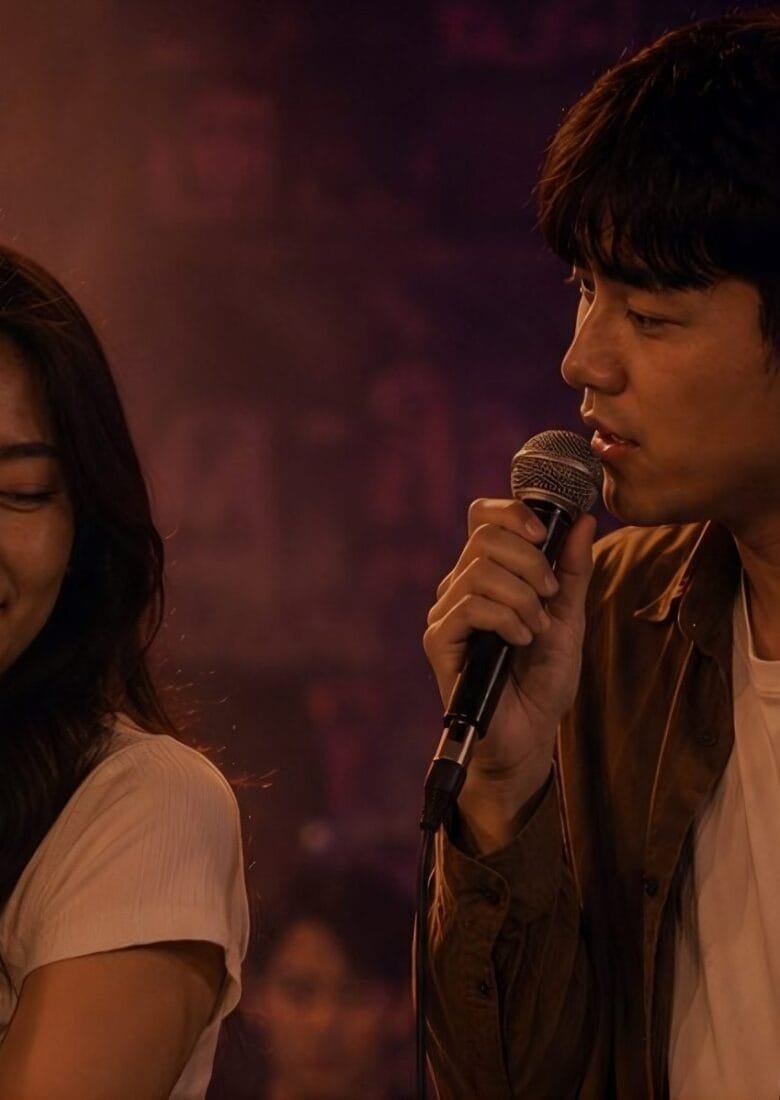
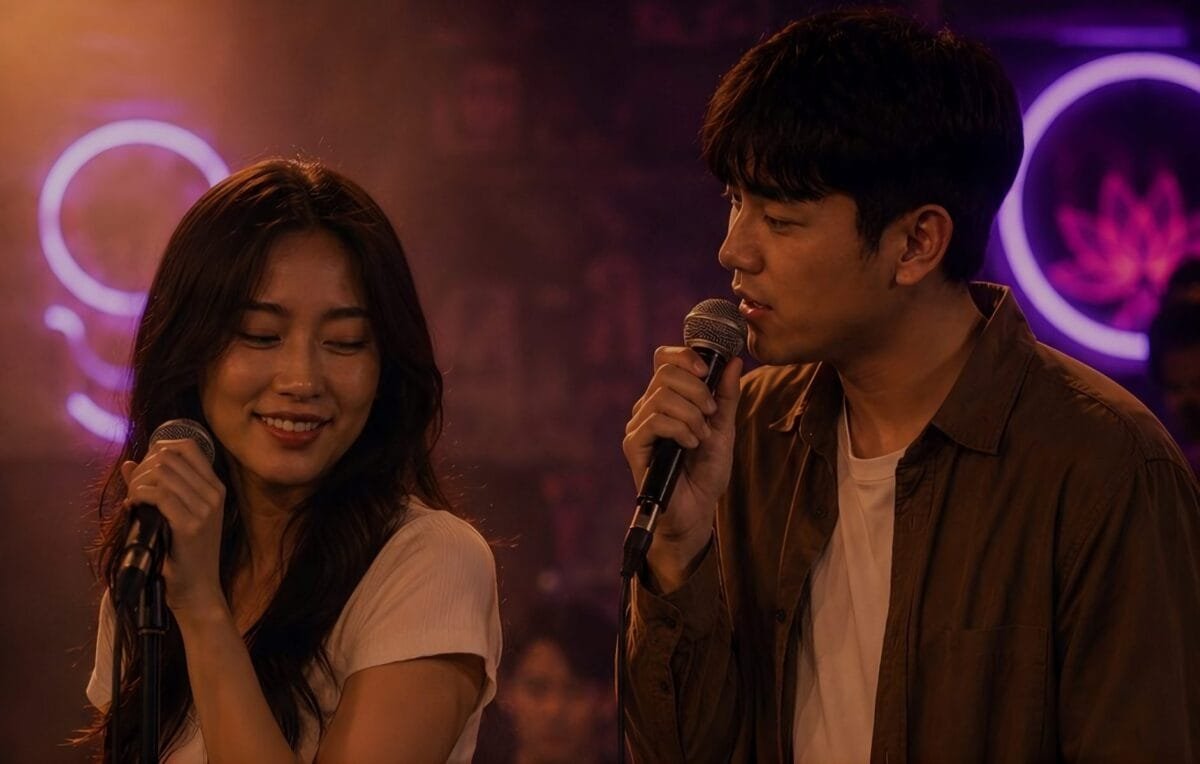
"Kit Teung Teu does not try to imitate mainstream Thai pop music perfectly. It does something more personal. It takes the emotional world of Ajarn David’s poetry and moves it into music. The result is a Thai love song written from the edge between two languages."
A Thai Love Song from an Unexpected Source
A
n American university lecturer living in rural Thailand is probably not the person most listeners would expect to write a Thai love song.
But that is exactly what Ajarn David has done with “Kit Teung Teu” (คิดถึงเธอ), a bilingual Thai-English duet that grew out of the same emotional and bilingual themes that have shaped his poetry for years.
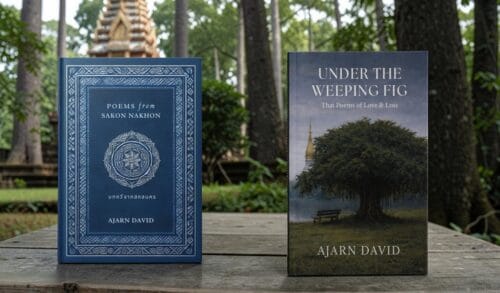
Best known as the author of Poems from Sakon Nakhon and Under the Weeping Fig, Ajarn David has spent more than two decades writing about Thai language, Isaan life, love, Buddhism, and the emotional territory that exists between Thai and English.
“Kit Teung Teu” feels less like a sudden jump into music than a natural extension of that work.
The song itself is simple on the surface. The male voice sings in English. The female voice answers mostly in English too, but opens with the exasperated Thai phrase “Phrajao loei.”
The result is a Thai love song with English lyrics that gradually becomes more emotionally layered the longer it goes on.
From Bilingual Poetry to Thai Love Song
A
jarn David’s earlier books already pointed toward this kind of project. Poems from Sakon Nakhon is rooted in place, Buddhist reflection, Isaan life, and everyday Thai experience.
Under the Weeping Fig moves more deeply into themes of unrequited love, memory, and emotional uncertainty. Both collections move between English and Thai without treating either language as secondary. That same tension sits at the center of “Kit Teung Teu.”
The phrase itself means something close to “I miss you” or “I’m thinking of you,” though neither English version completely lands in the same emotional place as the Thai expression.
In Thai, the feeling can seem softer, quieter, less declarative. That difference matters to the song.
The emotional problem is not just romantic. It is linguistic. The male character struggles to express himself clearly. The female character seems frustrated by his hesitation.
Both are trapped inside the same uncertainty, but they approach it differently. That emotional circling feels very familiar in Thai music.
Why the Love Song Feels Thai
A
lot of Western love songs move quickly toward confession or emotional release. Thai love songs often seem more comfortable lingering inside uncertainty itself.
Waiting matters. Not knowing matters. Missing someone quietly matters.
“Kit Teung Teu” follows that emotional logic closely. Even at the end of the song, the chorus is still asking: roo mai wa, “Do you know?”
No answer ever comes. That unresolved feeling is part of what gives many Thai love songs their emotional pull. The listener is left sitting inside the feeling rather than being guided cleanly out of it.
One of the strongest details in the song is hidden inside the structure of the chorus itself.
The male voice sings “Kit Teung Teu” once. Then the female voice repeats it twice back to him. Early in the song, her repetition can sound teasing — almost as if she is throwing his own feelings back at him rather than fully admitting her own. There is a playful edge to it, especially after his awkward opening verse.
But something changes as the song continues. By the later choruses, her repeated “Kit Teung Teu” no longer sounds playful or sarcastic. Without changing the lyrics at all, the repetition begins to feel emotionally sincere.
The listener gradually realizes she may have meant it from the beginning. By the final chorus, it no longer sounds like one person confessing feelings while the other person jokes about them.
It sounds like two people trying to admit the same thing at different speeds.
The English & Thai Lyrics of “Kit Teung Teu”
Verse 1 – Male
Why do you make it so hard for me
To say the things I want us to be,
You love your English, it’s oh, so cool,
But when I try, I sound like a fool.
Chorus – Duet
kit teung teu,
kit teung teu, kit teung teu,
kit teung teu,
kit teung teu, kit teung teu,
kit teung teu,
kit teung teu, kit teung teu,
roo mai wa,
kit teung teu.
Verse 2 – Female
Oh, Phrajao loei, here we go again,
I’m so tired of all you men,
Tell me what you want from me,
Then maybe you’ll finally see.
Repeat Chorus – Duet
Verse 3 – Male
Why are you always mean to me,
You said tonight you’d come see me,
I sit alone and wait for you,
Wondering what I mean to you.
Repeat Chorus - Duet
Verse 4 – Female
Look at you now with all your English,
I thought you said you sound foolish,
If only you knew how I really feel,
Then you’d know it’s hard for me too.
Final Chorus – Duet
A Foreigner Writing in Thai, But Not from the Outside
T here is something easy to misunderstand about a foreigner writing a Thai love song. From a distance, it can sound like a novelty.
But Ajarn David’s work has never really approached Thailand from the outside. He has lived in Thailand for more than twenty years, taught Thai university students, raised a family here, and built a body of writing centered around Thai language, Isaan life, Buddhism, and everyday emotional experience. That background matters.
“Kit Teung Teu” does not try to imitate mainstream Thai pop music perfectly. It does something more personal. It takes the emotional world of Ajarn David’s poetry and moves it into music.
The result is a Thai love song written from the edge between two languages.
Ajarn David wrote both the lyrics and melody himself. Writing bilingual songs in both Thai and English adds an extra layer of difficulty to the process, since the lyrics not only need to express genuine emotion, but also fit naturally within the melody, rhythm, and phrasing of two very different languages.
He first recorded a rough a cappella version before using AI-assisted music tools to help shape the final duet recording. The interesting part of that process is not really the technology itself. What matters is that the song began as a human voice trying to solve a human emotional problem that had already appeared many times in the poetry.
In that sense, “Kit Teung Teu” feels less like an AI music experiment and more like another step in Ajarn David’s larger body of bilingual creative work aimed at promoting Thai language and culture.
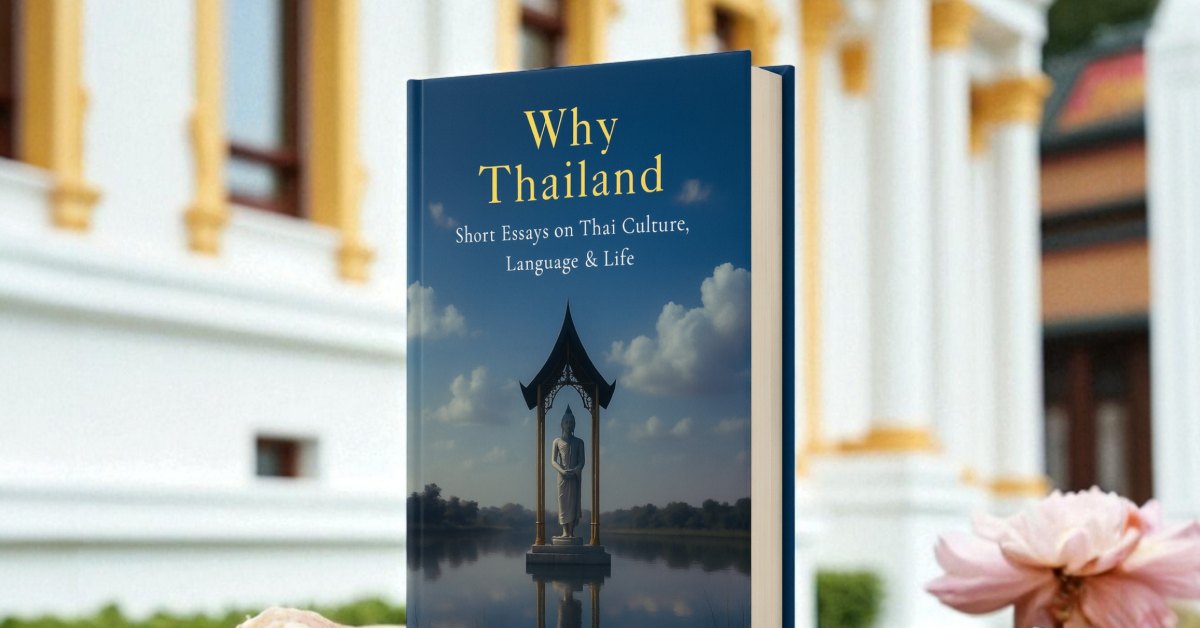
A Thai Love Song for Two Different Audiences
F
or Thai listeners, the song creates a subtle reversal. English becomes the awkward language — the language of insecurity and hesitation. The male character feels clumsy inside it.
Thai, meanwhile, becomes the language of direct emotional feeling.
For international listeners, the experience works in the opposite direction. English provides the entry point into the story, while the repeated Thai chorus slowly becomes the emotional center of the song.
By the end, even listeners who do not understand Thai can feel the emotional weight of kit teung teu.
That may be the most interesting thing about the song. It does not explain Thai emotion from the outside. It simply lets listeners hear it, repeat it, and gradually settle into it.
“Kit Teung Teu” is a Thai love song written by a foreigner, but it is not foreign to the feeling it carries.