"Poems from Sakon Nakhon gives readers a Thailand that feels specific rather than packaged. Its first poem opens with the rainy season and how it transforms the province. Later poems move through hot-season rest spent drinking sato in a sala, the ancient Khmer ruins atop Phu Phek where ancestral spirits wait, and the forest paths of Phu Phan where barefoot monks seek enlightenment."

W
hen Poems from Sakon Nakhon climbed to No. 27 in Amazon's Thailand Travel category and entered the Top 100 in Poetry About Specific Places, the more interesting question wasn't that a poetry book had ranked well.
It was why a bilingual Thai poetry collection from one of Thailand's least internationally known provinces was appearing beside books that serve a much more practical purpose.
Travel readers typically buy books to help them make decisions. Where should I go? What should I see? How do I understand the country before I arrive?
Poetry is presumed to belong to another shelf altogether — private, literary, inward-looking.
A Thailand travel guide promises usefulness. A Thai poem promises something less obvious. Yet that gap may be the very thing that explains the ranking.
Some readers searching for Thailand books are looking for something the usual format can't give them. Not another list of beaches or Bangkok itinerary, but a way to feel their way into the country — through language, landscape, humor, longing, Buddhist thought, village life, and the small particular moments that never fit neatly into a guidebook.
They are not only buying Thai poetry. They are buying cultural discovery.
The Strange Position of Poetry in the Book Market
Poetry occupies a peculiar place in publishing. It carries enormous cultural prestige but has never been an easy commercial category.
Many readers admire it in theory while rarely buying it in practice — they remember poems from school, weddings, funerals, or social media, but don't necessarily browse the poetry section looking for a new collection.
In recent years poetry has found new readers through social media, spoken-word performance, and visually simple collections designed for readers who may not think of themselves as literary specialists.
Rupi Kaur's milk and honey, first self-published in 2014, became one of the most visible examples, eventually selling millions of copies worldwide. In the United Kingdom, poetry sales reached record levels in 2023. But the revival hasn't been limited to short inspirational verse.
Readers have simultaneously shown growing interest in translated literature, international voices, and regional writing outside the usual English-language publishing circuit.
Readers are more willing than before to cross linguistic and cultural borders — which helps explain why a bilingual poetry book about Sakon Nakhon might find an audience well outside the normal poetry readership.
Why Readers May Be Coming Through the Travel Door
A
reader searching for books about Thailand is often searching for orientation that is less practical than emotional.
People want to know what kind of country they are approaching, what daily life feels like beyond the resort, the café, the temple photograph, and the familiar phrases about smiles and hospitality.
Traditional guidebooks once performed some of that work. But maps, restaurant listings, opening hours, transport advice, and hotel reviews have largely migrated online. What remains valuable in a book is not always information. It is interpretation.
A book still has the power to gather scattered impressions into a coherent way of seeing. Poems from Sakon Nakhon sits in that position — unexpectedly useful precisely because it makes no claim to usefulness.
It doesn't tell readers where to eat lunch in Sakon Nakhon or how to book a hotel near Nong Han lake. It gives them rain arriving across rice fields, temple drums at dusk, a late-night noodle seller serving bowls of guaitio to lonely people, forest monks in saffron robes chanting in caves where tigers once kept their dens, local legends, Thai emotional vocabulary, and the quiet comedy of cross-cultural life.
For a certain kind of reader, that is more valuable than another itinerary.
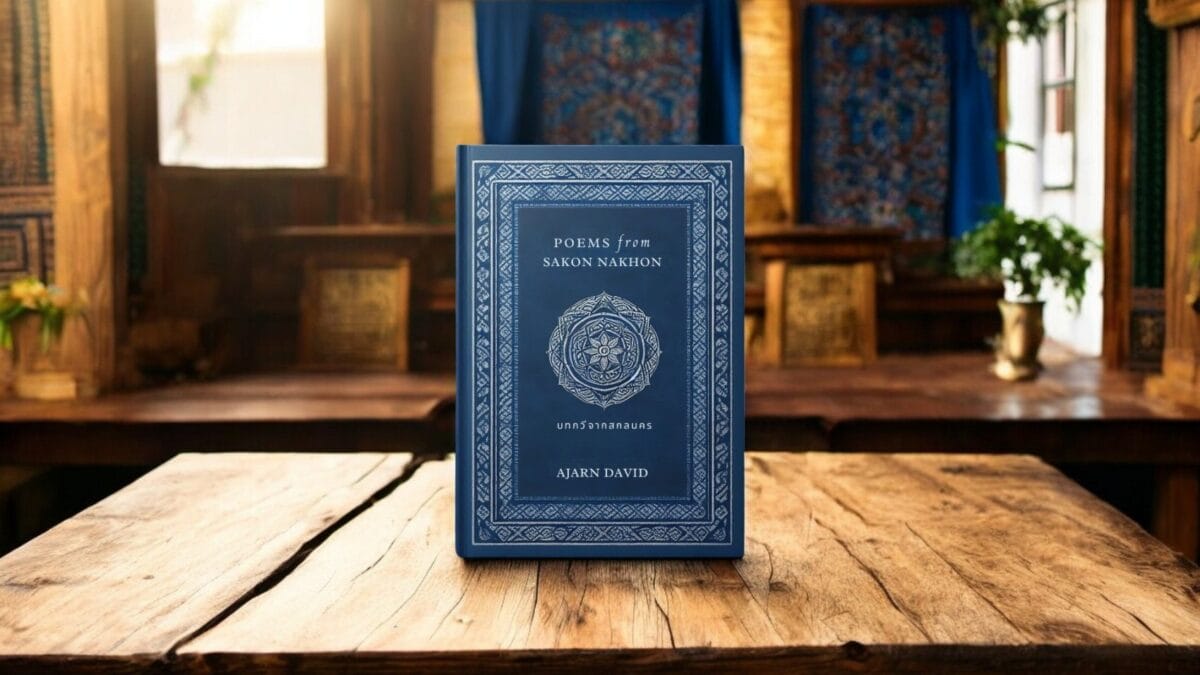
Poems from Sakon Nakhon is available in hardcover, paperback, and Kindle ebook.
A Different Kind of Thailand Book
M
ost English-language books about Thailand begin from a recognizable set of subjects: Bangkok, beaches, temples, nightlife, retirement, food, culture shock.
These are simply over-represented. They create a version of Thailand that is vivid but narrow, as though the country exists mainly where outsiders most often gather. Poems from Sakon Nakhon begins somewhere else entirely.
Sakon Nakhon is not a standard international destination. It is a northeastern province associated with forest monasteries, Nong Han lake, the Phu Phan mountains, indigo-dyed textiles, Khmer ruins at Phu Phek, and the ordinary rhythms of Isaan life.
For many foreign readers, even the name may be unfamiliar — and that unfamiliarity is part of the book's appeal. It has no existing image to confirm or complicate. The collection gives readers a Thailand that feels specific rather than packaged.
Its first poem opens with the rainy season and how it transforms the province. Later poems move through hot-season rest spent drinking sato in a sala, the ancient Khmer ruins atop Phu Phek where ancestral spirits wait, the forest paths of Phu Phan where barefoot monks seek enlightenment, and the rice fields if Hawm Dawk Hung, where three hundred varieties of rice grow.
The book is also grounded in specific historical figures tied directly to Sakon Nakhon. One poem follows the final days of Ajarn Mun Bhuridatto, the revered forest monk who, sensing his death was near, deliberately left the forests he'd called home for over fifty years.
Another describes HRM King Bhumibol, who built his first Royal Residence in Isaan on a hill in Phu Phan, close to his friend Ajarn Fun Acharo, a forest monk whose humility was an inspiration to the king. What holds these Thai poems together is a method: the compression of poetry doing what prose essays usually do, but in a fraction of the length and with considerably more staying power.
A conventional cultural essay might take several pages to explain greng-jai. The poem gives the reader not a definition but a posture — a heart in awe of others' solitary struggles, their secret burdens. A poem about mee nam-jai turns a common Thai phrase into something felt rather than explained. The poem on ruk — the Thai word for love — doesn't translate it; it listens to the sound of the work.
The poem on sia naa, losing face, makes the concept physical, comparing it to rotten jackfruit. These are not cultural footnotes. They are doing real interpretive work, and they do it in ways that stay with a reader long after a prose explanation would have faded.
The Bilingual Format and Its Uses
The bilingual structure — English, Thai script, and romanized transliteration on each page — changes the reader's relationship to the material in a way that matters practically, not just aesthetically.
In a monolingual English collection, Thai cultural terms must either be translated away or explained from a distance. In a bilingual edition, the Thai remains present. The reader is not asked to pretend everything has crossed neatly into English. The script reminds English-language readers that the culture being described is not reducible to English explanation.
The transliteration, explained through a consistent system at the back of the book, gives readers a way to sound out words they may have heard in Thailand but never seen written. This makes the book useful to several audiences at once: Thai language learners, travelers, expatriates who want language for things they've felt but never articulated, Thai readers interested in English, and people who simply want a more intimate Thailand book than the ones currently on offer.
It also removes one of poetry's traditional barriers — readers who feel intimidated by poetry may feel more comfortable when the poem offers another clear purpose. They are reading to understand a word, a place, a season, a belief, not to demonstrate literary sophistication.
The author — Ajarn David, an English lecturer who has taught at Thai universities for over twenty years — has spent long enough in Sakon Nakhon to write not as a tourist processing impressions but as someone for whom the place has become the texture of daily life.
That familiarity is what allows the collection to move between categories so easily: poetry book, cultural guide, language companion, regional portrait, and act of translation between worlds, all at once.
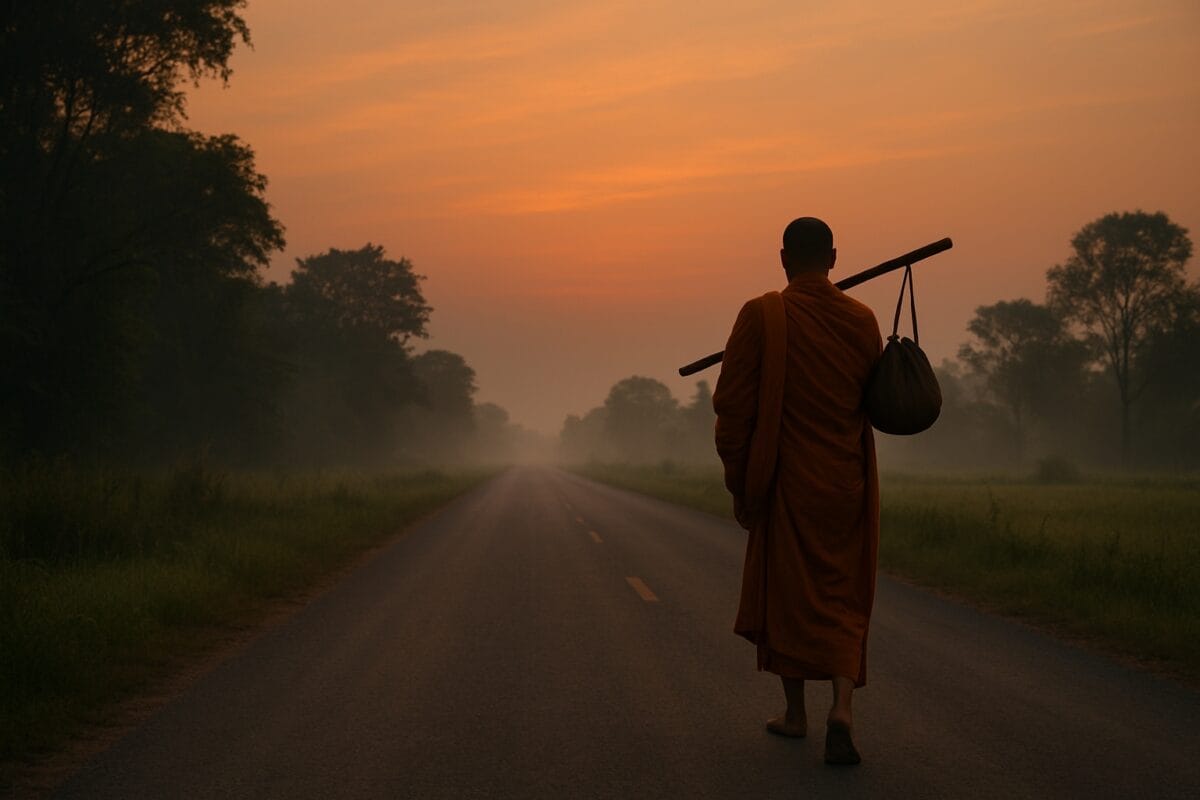
Poems from Sakon Nakhon features 92 bilingual Thai-English poems.
Buddhism Without Postcard Spirituality
M
any books about Thailand use Buddhism as atmosphere: saffron robes, temple bells, gold statues, incense smoke. Poems from Sakon Nakhon is more interested in Buddhism as practice, discipline, and thought.
Sakon Nakhon is deeply associated with the Thai forest tradition — the tradition of Ajarn Mun, Ajarn Fun, and Ajarn Wan Uttamo, all of whom appear in the book. The poem on Khao Phansa, the monks' three-month rains retreat, is characteristic of the book's approach: it begins with the monastic calendar, then turns inward.
A poem on the Eightfold Path arrives not at abstraction but at patience — the one thing you must bring when lost in the woods, when the rain comes, when your faith wavers. A poem about the First Noble Truth turns suffering into an image of holding the stem of a blooming flower.
One of the book's finest follows Ajarn Wan Uttamo, who walked through darkness on a full moon night in 1970 as soldiers shouted "Stop!" and then opened fire. He kept walking, unhurt, and dismissed the soldiers' horrified concern.
These are accessible Thai Buddhist poems. They are not shallow ones.
Humor Keeps the Door Open
A book dealing with Buddhism, loneliness, longing, aging, and the ache of never fully belonging somewhere could easily tip into solemnity. One of the collection's genuine strengths is that it understands Thailand through humor as fully as through reverence.
The late-night noodle seller becomes an angel in disguise. The durian stands for love and hate simultaneously. The word farang is treated with a shrug, rather than a slight.
This humor is part of the cultural intelligence, not decoration. Thailand is often misread by outsiders who mistake gentleness for simplicity or playfulness for lack of seriousness.
The poems push back — showing a culture where lightness can be intelligence, teasing can be social wisdom, and the person who takes everything with the utmost gravity may be closing doors that a well-placed laugh would have opened.
The sacred and the ordinary share the same page without awkwardness, because in Sakon Nakhon they typically do.
What the Ranking Actually Signals
The Amazon ranking should not be over-interpreted. One book's performance doesn't prove a revolution in publishing. But it does point toward a gap: readers interested in Thailand may be far more open to literary and bilingual forms than the market currently assumes.
English-language publishing has long treated Thailand through a narrow commercial lens. Books about Bangkok, beaches, food, nightlife, and expat life are easier to categorize.
A bilingual poetry collection from Isaan is harder to place — too literary for a standard travel guide, too accessible for academic ethnography, too local to fit the usual international image of Thailand.
Those apparent disadvantages may be precisely what make it distinctive. It doesn't compete with guidebooks for information. It occupies different ground.
For Readers Who Thought They Wanted Something Else
The most revealing thing about the success of Poems from Sakon Nakhon is that it doesn't require readers to arrive as poetry lovers. Some come because they are planning a trip to Thailand, or have lived there and want language for things they've felt but never articulated, or are studying Thai, or are interested in Buddhism, Isaan, or the emotional vocabulary of another language.
Some stumble on it through Amazon's recommendation engine with no particular intention of reading poetry at all. Then, almost by accident, they find themselves reading it.
The book doesn't argue that poetry is important. It demonstrates that poetry can still do something other forms struggle to do: condense a culture without reducing it, make a Thai word memorable without reducing it to a definition, turn a season into a state of mind, a lake into a love story, a bowl of noodles into a small act of grace, a forest into a spiritual inheritance.
In a time when practical information about Thailand is freely available everywhere, a deeper orientation remains harder to find.
Poems from Sakon Nakhon found its audience by offering something the market had left room for: a bilingual poetry collection that behaves like cultural discovery.
For readers who thought they were looking for Thailand, it offers Thai poetry.
For readers who thought they did not read poetry, it offers Thailand.
Read about Ajarn David's followup book of bilingual poetry: Under the Weeping Fig (Thai Love Poems).