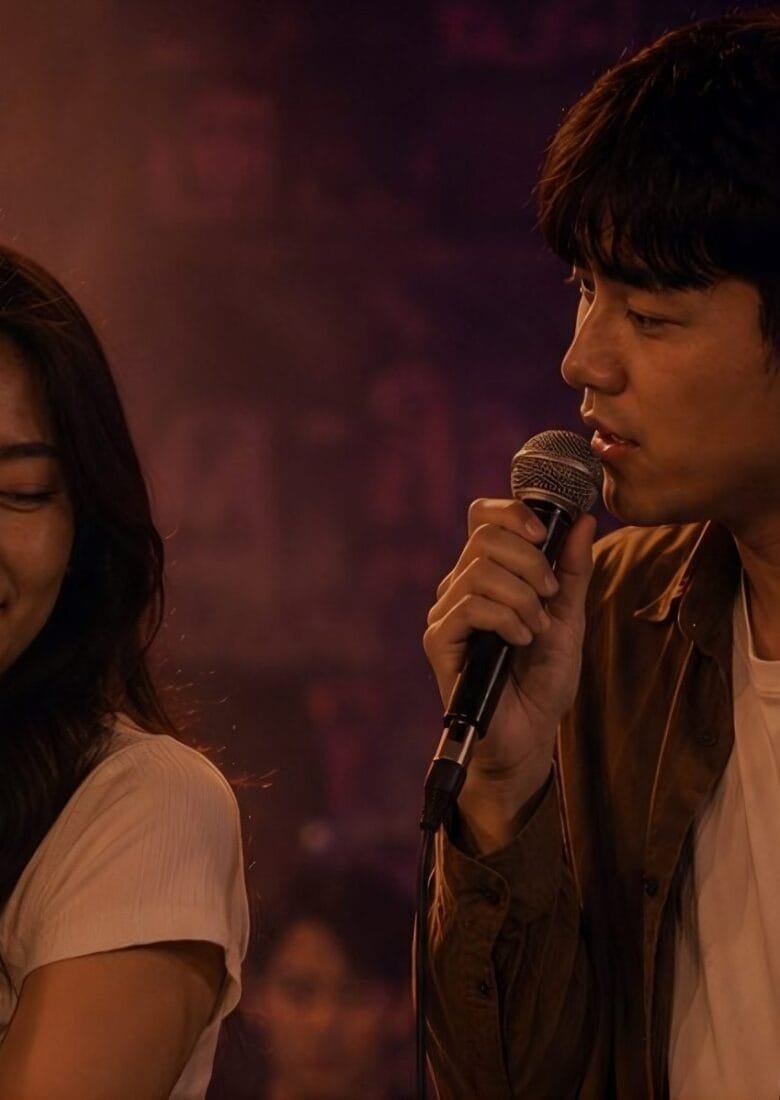
A songwriter like Ajarn David can land a complete emotional idea in just a few syllables. That's valuable in a ballad, because every extra word eats musical time — fewer syllables needed to say the thing means more time available to stretch and shape the ones you keep.
T
here was a time when a love song didn't need many words.
A singer could hold a single phrase over a rising arrangement, stretch one vowel almost to its breaking point, and say more in a few seconds than another song might say in an entire verse.
That's one of the ideas behind "Mai Rak Lai Jai" (ไม่รัก หลายใจ), a Thai-English love song whose roots reach back past contemporary Thai pop to the torch songs of the 1950s and the dramatic pop ballads of the 1970s — songs where melody and space did as much work as the lyrics.
Ajarn David has described the goal as creating something emotional but also unusually simple: easy to remember, easy to sing, and open to both Thai and foreign singers to perform.
The song also raises an interesting question: might Thai itself be an especially good language for this kind of ballad? There are good reasons to think it might be. But first, some background on where this style comes from.
From the Torch Song to the 1970s Ballad
L
ong before "power ballad" meant arena rock, electric guitars, and stadium-sized choruses, singers were already discovering what happens when you leave space around a lyric.
The torch-song tradition made a whole art form out of it — songs about longing and loss where a simple line, held a certain way, could hit harder than a page of clever writing. The emotional weight lived in the interpretation: how long a note was held, where the voice cracked, where it let go.
By the 1970s, the arrangements around that idea had gotten bigger. Strings, dramatic piano, quiet openings building to enormous vocal climaxes.
Eric Carmen's "All By Myself" is the obvious example — built in part around a melody borrowed from Rachmaninoff's Second Piano Concerto, it turns loneliness into something expressed as much through musical scale as through lyrics. It hit No. 4 on the Billboard Hot 100 in 1975 and found a second life when Celine Dion covered it in the '90s.
What's striking about the chorus is how little language it needs; the title phrase becomes huge simply because the singer is given the room to make it huge. Not every song in this tradition was about heartbreak.
Debby Boone's "You Light Up My Life" runs the same idea in the opposite emotional direction — hope and fulfillment instead of loss — but the songwriting principle is the same: start intimate, let the arrangement grow, and give the important words enough space to carry the climax.
Ajarn David has said that these were the kinds of songs he had in mind while writing "Mai Rak Lai Jai," drawing both on favorite ballads from the 1970s and the older torch-song tradition.
Writing a Ballad by Taking Words Away
The song opens with an English verse:
This is the end.
There's nothing left for us to mend.
Nothing left now to pretend.
Don't try again.
The language is deliberately plain. We don't learn how the couple met, how long they were together, or what exactly went wrong. We only know what matters: it's over.
The second verse steps back briefly —
There was a time when I'd beg you not to walk away.
Today is not that day.
Just go away.
— before the final verse returns to where it started:
This is the end.
There's nothing left for us to mend. Nothing left now to defend.
Go love again.
Between the verses sits a much simpler Thai chorus:
ไม่รัก…
หลายใจ
จบวันนี้
ไม่รัก…
หลายใจ ไปซะที
Mai rak… lai jai.
Jop wan-nee.
Mai rak… lai jai.
Pai sa-tee.
What matters here isn't just that the phrases are short — it's what the shortness lets the music do.
"หลายใจ" (lai jai) gets stretched, but the closing phrases — "จบวันนี้" (jop wan nee) and "ไปซะที" (pai sa tee) — get stretched even further.
By the time the voice reaches those final syllables, it's not delivering information anymore. It's just carrying feeling.
The song exists in two versions with identical lyrics: a female piano version, "ฝั่งเธอ," and a male acoustic-guitar version, "ฝั่งเขา." Same words, different voice, different arrangement — and the emotional experience changes completely.
The lyric holds still; the feeling moves around it. That's a very old trick, going back to the torch singers, and it still works.
Thai May Be Built for This
W riting the chorus also points to some real advantages Thai may have for this kind of ballad.
Look at how much a short Thai word or phrase can carry:
• รัก — love
• ไม่รัก — don't love
• คิดถึง — miss, long for
• เสียใจ — heartbroken, sorry
• หลายใจ — unfaithful, more than one love
• กลับมา — come back
• ลาก่อน — goodbye
• ไปซะที — just go, finally
A songwriter can land a complete emotional idea in just a few syllables.
That's valuable in a ballad, because every extra word eats musical time — fewer syllables needed to say the thing means more time available to stretch and shape the ones you keep.
Thai's tonal nature complicates this in an interesting way. In Thai singing, the relationship between lexical tone and melodic contour matters: melody can reshape the spoken tone, but push the two too far apart and intelligibility can suffer.
That constraint doesn't rule out the power-ballad approach — if anything, it rewards finding the one short phrase whose natural tonal shape already fits the melody, so it can be repeated and stretched without a fight between language and music.
The "Sabai Sabai" Comparison
There's already a well-known example of how far a tiny Thai phrase can carry a song: Bird Thongchai's "สบาย สบาย" (Sabai Sabai).
It's nothing like a power ballad — completely different emotional register — but it makes a related point about economy. The phrase is instantly graspable and rhythmically catchy; nobody needs to learn a complicated chorus before they can sing along.
"Mai Rak Lai Jai" takes that same economy somewhere else. Instead of "Sabai, sabai" used for rhythmic hookiness, "Mai rak… lai jai" slows down and asks the same kind of short phrase to carry weight instead of charm. One makes a small phrase catchy. The other tries to make a small phrase hurt.
Built to Be Sung
The song was also deliberately designed to be singable by people who aren't fluent in both languages.
The English verses use plain vocabulary and tight rhyme — end / mend / pretend / again, away / day / away — so Thai singers aren't fighting unfamiliar words.
The Thai chorus, in turn, only asks a non-Thai speaker to learn a handful of short phrases. Neither audience has to do much work before they can join in.
Ajarn David has said that this accessibility was one of the design goals from the beginning: to create something emotional, easy to sing and easy to remember, and particularly suitable for both Thai and foreign singers.
A ballad doesn't need to impress anyone with vocabulary. Often its whole strength is that by the time the big emotional moment arrives, the listener already knows the words that are coming, and can sing them too.
Where This Could Go in the Thai Music Scene
T
hai popular music already has a long, rich history of emotional balladry — this isn't an argument that dramatic singing is new to Thai music.
The more interesting question is narrower: what happens if more songwriters lean into the specific lyrical economy of the old torch song and the 1970s ballad, applied to Thai — not by copying 1975 American production, but by taking the underlying idea (say less, give the singer more room) and building something new with it.
Thai singing has always evolved through this kind of exchange between Thai musical and linguistic tradition and outside influences.
The power ballad might be one more place for that exchange to happen — not by writing bigger, busier choruses, but by finding the right two words, giving them the right melody, and then getting out of the singer's way.
That's one of the ideas "Mai Rak Lai Jai" leaves behind, especially for the Thai indie music scene. Maybe there are more Thai power ballads like it waiting to be written.
To listen to a collection of emotion driven Thai love songs check out this: Thai Song Playlist on Spotify.