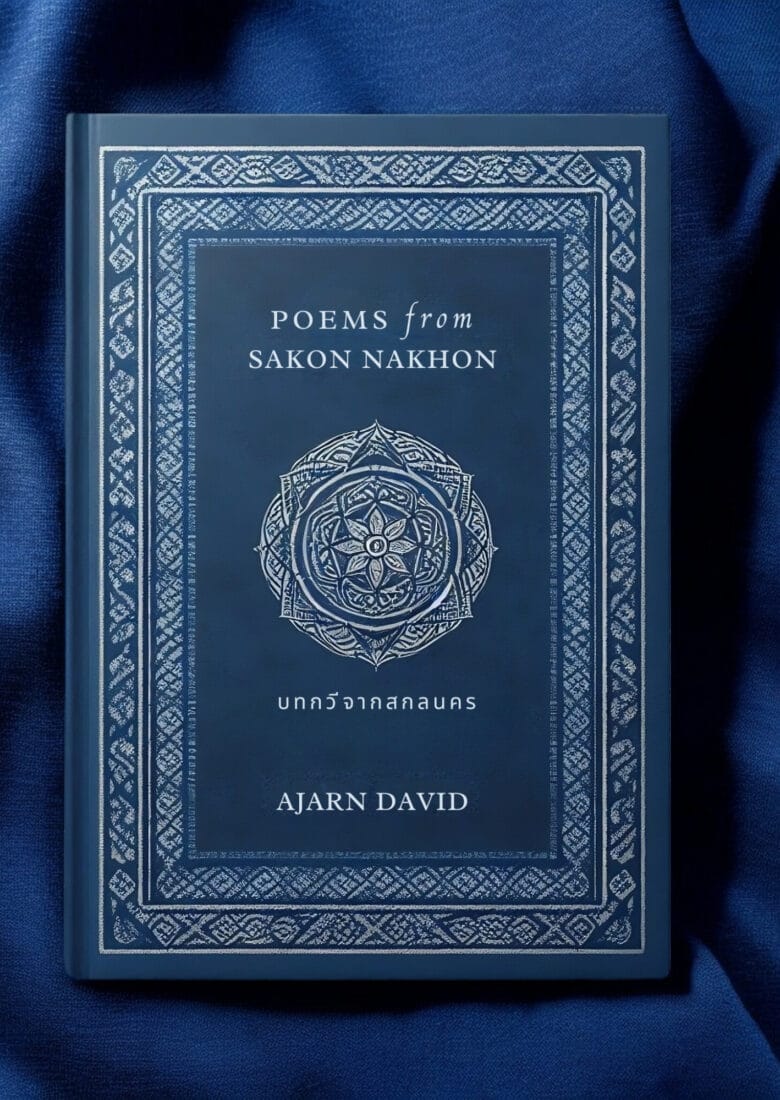
"Rak Sakon Nakhon" isn't a romantic love song in the conventional sense, but it borrows the form of one: two voices, repeated invitations, longing, a chorus built around rak, "love." The beloved just happens to be a place rather than a person. That's why the nirat framing fits so well, and why the duet structure isn't incidental.
A Journey Song in the Nirat Tradition
T
hai literature has long had a genre built around the ache of distance: the nirat, a journey-poem in which travel through a landscape becomes a vehicle for longing — for a lover, a home, a life left behind.
"Rak Sakon Nakhon" (รักสกลนคร) echoes that tradition, although its journey moves toward home rather than away from it. The song opens with an invitation — Let's ride — and then moves through mountains, temples, a lake, a waterfall, a village, shops, a forest, and shared meals.
On its surface it sounds like a musical tour of Sakon Nakhon province. But it isn't a song about discovering somewhere new. It's a song about the last stretch of road before you're home, sung by someone for whom that stretch of road is real.
Written by Ajarn David, an American university lecturer who has lived in Thailand for more than two decades, the song is a bilingual Thai-English duet rooted in the corner of Isaan where he has raised his family.
Musically, it sits in Thai folk pop, built around acoustic instrumentation — a warmer, more intimate register than a produced pop ballad, and one that suits a song about a place rather than a person.
Its landmarks aren't presented as a checklist. They're attached to ordinary pleasures: riding together, buying indigo cloth, sitting by the lake, climbing temple steps, hunting mushrooms, eating with family, making merit with one's parents. That's what keeps the song from becoming a tourism jingle — it's specific in the way only lived experience is specific.
I Love Sakon Nakhon
R
ak Sakon Nakhon means "Love Sakon Nakhon" or "I love Sakon Nakhon." Thai routinely omits the subject of a sentence, so the title works two ways at once: as the author's personal declaration, and as an invitation extended to whoever's listening.
That openness fits the duet structure. The song belongs to neither voice exclusively — the two singers trade English lines, then join for the Thai chorus. One proposes a destination; the other proposes the next.
The English verses make the places legible to listeners who know nothing about Sakon Nakhon. But the Thai place names and cultural terms are never swapped out for approximate English equivalents.
The song isn't trying to make the province more familiar to outsiders — it's asking them to enter its vocabulary as it actually is.
The chorus is where the song's emotional center sits:
Sakon Nakhon, glai theung baan (สกลนคร ใกล้ถึงบ้าน) — Sakon Nakhon, we're almost home.
Khit theung jang, cheewit chao-ban (คิดถึงจัง ชีวิตชาวบ้าน) — I miss it so much, the life of ordinary country people.
Rak Isaan, thung-naa suay-ngaam (รักอีสาน ทุ่งนาสวยงาม) — I love Isaan, its beautiful rice fields.
Rak Sakon, glai theung baan (รักสกล ใกล้ถึงบ้าน) — I love Sakon, we're almost home. Glai theung baan literally means "close to reaching home."
The chorus doesn't treat home as a fixed point on a map — it treats it as something approaching, felt in motion.
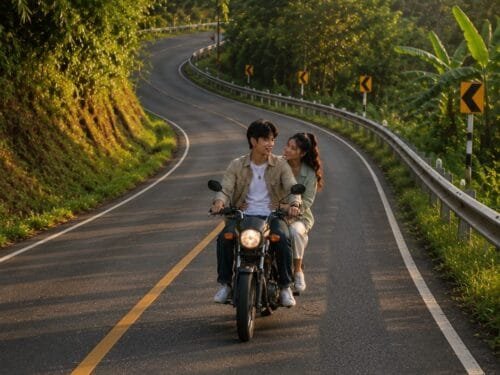
Traveling Phu Phan by Motorbike is a Popular Isaan Pastime
Riding Through Phu Phan
L
et's ride through the Mountains of Phu Phan (ภูพาน)" sets the song moving immediately.
The Phu Phan range forms the mountainous spine of Sakon Nakhon, its roads curling through forested hills before dropping toward the city and the plain around Nong Han.
For anyone returning by road — especially by motorcycle — those mountains function as a threshold. Once the familiar curves appear, the province no longer feels far off.
The song puts the listener inside the mountains rather than looking at them from a distance, and it does something else worth noting: it sets up a tension the rest of the song will keep returning to.
Riding suggests freedom and open road. The chorus that follows points the other way, toward home. The journey has momentum precisely because it's also a return.

Sakon Nakhon is recognized worldwide for its Indigo textiles.
Indigo as the Color of Sakon Nakhon
T he female voice answers: "Let's go shopping for phaa see khraam (ผ้าสีคราม)" — indigo-dyed cloth.
Natural indigo is one of Sakon Nakhon's most recognizable crafts. Indigo leaves are fermented into dye, and repeated dipping deepens the cloth from pale blue toward the dark tones the province is now known for; Sakon Nakhon has been promoted as a world craft center for natural indigo, and its textiles carry Thai Geographical Indication status.
The Tourism Authority of Thailand and The Colours of Thailand both document the plant-based dyeing process and its continued place in local life.
The line's phrasing matters: it says "let's go shopping," not "let's study traditional textile heritage." Culture here is something worn, bought, given, brought home — folded into daily life rather than roped off as heritage.
It's also the song's first human-made image; the mountains gave us landscape, indigo gives us the hands that work within it.

Nong Han Lake in Sakon Nakhon is a popular place to relax.
Nong Han: The Song's First Pause
L
et's sit by the waters of Nong Han (หนองหาร)" slows everything down.
Nong Han, the vast freshwater lake beside Sakon Nakhon city, covers more than 30,000 acres and supports agriculture, fishing, and daily life along its shores, alongside its recreational and ecological value — it plays an important role in local livelihoods, while the Stockholm Environment Institute documents its broader environmental significance.
The lyric asks the listener to do nothing there but sit — one of the simplest and most telling lines in the song, because it suggests Sakon Nakhon isn't valued only for what can be done or photographed.
After the motion of the mountains and the errand of shopping, the lake offers a beat of stillness, and its position beside the city explains why it doubles so naturally as a symbol of home: it's not a destination so much as a daily backdrop, the place people pass, fish, and watch the sunset from without thinking twice about it.
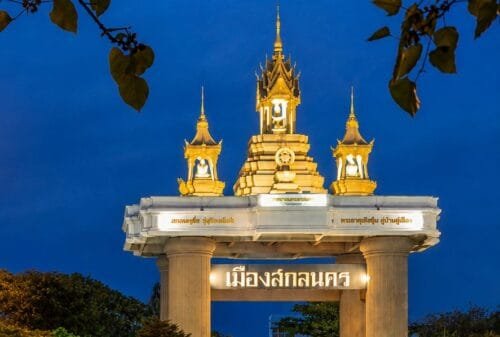
Sakon Nakhon is celebrated for its nature, culture, and spiritual life.
Returning to the City of Three Dharmas
T
he first verse closes: "Let's go home to mueang saam tham (เมืองสามธรรม)" — the City of Three Dharmas
The phrase names a tourism and cultural identity built on three ideas: thamma (ธรรมะ, spiritual life), thammachat (ธรรมชาติ, nature), and watthanatham (วัฒนธรรม, culture) — a framing Isan Insight, published by Khon Kaen University, traces through the province's forest monasteries, lakes and mountains, and local traditions.
What keeps the phrase from staying a slogan is that the rest of the song fills it in. Phu Phan, Nong Han, the waterfall, and Phu Pha Yon carry the nature; Phra That Phu Phek, Wat Tham Kham, and Ajarn Fan carry the Dhamma; indigo, mushroom-hunting, Tha Rae, Phon Yang Kham beef, som tam, and family life carry the culture.
The whole song, in effect, brings the idea of Sakon Nakhon as the City of Three Dharmas to life.

A steep climb is required to reach the ancient Phra That Phu Phek.
Climbing Toward the Past at Phra That Phu Phek
V
erse two opens: "Let's climb the steps of Phra That Phu Phek (พระธาตุภูเพ็ก)."
High in the Phu Phan range sits an ancient Khmer sandstone sanctuary, reached by a steep staircase traditionally counted at 491 steps.
The unfinished-looking structure, set on a laterite base and surrounded by forest, connects Sakon Nakhon to the older Khmer world that once extended across the region.
The verb matters — climb, not visit. It keeps the temple from becoming a decorative reference point and turns it into something the singers have to work for, together.
Sakon Nakhon, throughout the song, is experienced through verbs: ride, shop, sit, climb, wai, swim, hunt, make merit, eat. Love of place is shown by doing things in it.
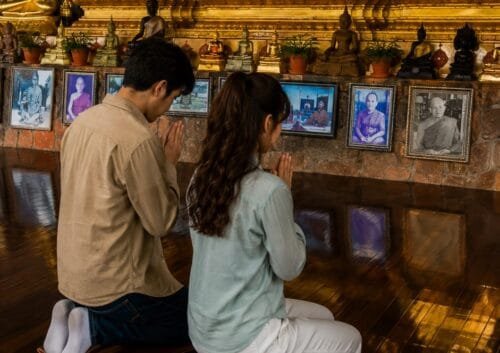
A steep climb is required to reach the ancient Phra That Phu Phek.
Paying Respect to Ajarn Fan at Wat Tham Kham
L
et's wai (ไหว้) Ajarn Fan (อาจารย์ฝั้น) at Wat Tham Kham (วัดถ้ำขาม)."
A wai — palms pressed together — is the Thai gesture of greeting, gratitude, and respect; here it carries devotional weight. Ajarn Fan Acharo (also Ajahn Fun, Luang Pu Fan), born in Sakon Nakhon in 1899, became one of the province's most revered meditation monks, a disciple of Ajarn Mun Bhuridatta within the Thai Forest Tradition.
Wat Tham Kham, set in the Phu Phan landscape, was one of his principal places of residence and meditation for nearly a decade. Thai accounts describe his residence and teaching at Wat Tham Kham from the mid-1950s until illness caused him to return to Wat Pa Udom Somphon in 1964.
The Khon Kaen University Cultural Center also preserves an account from one of the monks who studied under him there.
The line moves the song past sightseeing: the singers aren't visiting a building, they're honoring a teacher whose memory still shapes the province's identity.
It's a reminder that home is built from more than scenery and family — it's built from the people a community chooses to remember.
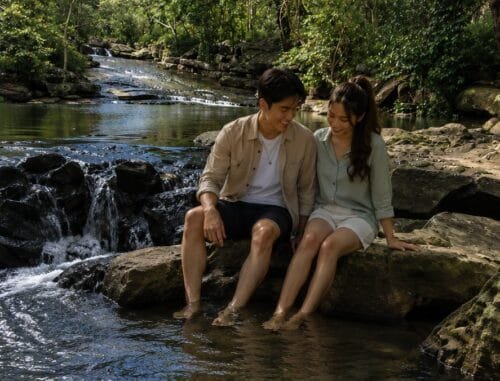
Sakon Nakhon is filled with rolling waterfalls in the mountians.
The Local Pleasure of Preecha Suksan Waterfall
T
he mood shifts again: "Let's swim the falls of Preecha Suksan (ปรีชาสุขสันต์)."
Preecha Suksan Waterfalls, in Ban Pracha Suksan, Tambon Khamin, sits roughly 25 kilometers from the city near Phu Phan National Park, where water runs across an 18-meter sandstone slope described by the local Khamin Subdistrict authority as a broad, naturally sloping "sliding board."
It's a strongly local spot rather than one of the province's headline attractions, and including it is a small but telling choice — this reads less like a curated list of landmarks and more like the itinerary of someone who actually knows where families go to cool off in the rainy season.
After the gravity of the temple and the wai, the waterfall restores playfulness, and the ease with which the song moves between reverence and fun is its own quiet argument for what the "three dharmas" actually look like in practice.
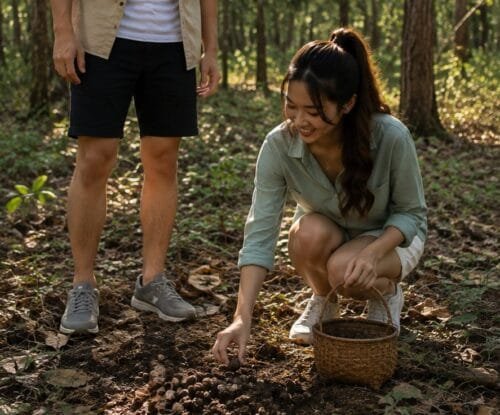
The Isaan people are skilled at mushroom hunting in the forests.
Hunting Mushrooms at Phu Pha Yon
T
he second verse closes with a hunt: "Let's hunt hed phor (เห็ดเผาะ) at Phu Pha Yon (ภูผายล)."
Phu Pha Yon National Park protects forested mountain country in and around Sakon Nakhon.
In the rainy season, Isaan forests produce wild foods gathered for generations, and among the most prized are hed phor — small, round earthstar mushrooms (the edible species Astraeus odoratus) that emerge in the sandy, lateritic soil in Sakon Nakhon around the start of the rains.
"Hunt" is the right word, not "collect" — the mushrooms stay half-buried under soil and leaf litter, and finding them takes attention, local knowledge, and some luck.
Where anyone can be shown a temple or brought to a lake, searching a forest for a specific seasonal mushroom is knowledge usually passed within families.
It's belonging demonstrated through skill, not just presence — and it connects the province's food directly to its forest floor, with no market or restaurant in between.

A steep climb is required to reach the ancient Phra That Phu Phek.
Stars over Ban Tha Rae
V
erse three opens: "Let's see the stars at Ban Tha Rae (บ้านท่าแร่)."
The stars refer to Tha Rae's Christmas Star Parade, as well as the Christmas lights that appear on homes throughout the village.
Ban Tha Rae is the historic center of one of Thailand's largest Roman Catholic communities, and each Christmas the streets fill with illuminated stars and star-covered floats recalling the Star of Bethlehem — a tradition more than a century old and now one of the province's best-known festivals.
Within the song's arc, Tha Rae adds a dimension that's easy to miss: after an ancient Khmer sanctuary and a Buddhist forest monk, the journey arrives in a Catholic community whose faith is just as inseparable from Sakon Nakhon's identity.
The line stays light — it doesn't pause to explain religious diversity, it just places it naturally inside the itinerary, sacred symbol and community festival at once.
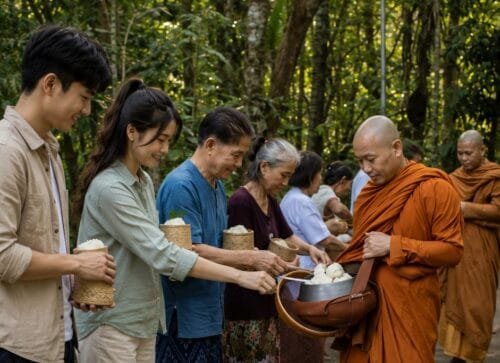
On Buddhist holidays, families line up to offer monks sticky rice.
Making Merit with Paw and Mae
T
he next line steps away from landmarks entirely: "Let's make merit with paw (พ่อ) and mae (แม่)" — father and mother.
Tham boon, making merit, can mean giving food to monks, donating to a temple, or simply performing a shared act of remembrance; in Thai family life, doing it together — accompanying parents to a temple, preparing offerings, dedicating merit to relatives — can carry as much weight as the act itself.
The lyric doesn't specify which act, because it doesn't need to: what matters is that it happens with paw and mae. This is the point where the song's homecoming theme stops being implied and becomes literal.
Mountains and lakes can be revisited any time; parents can't be, indefinitely. And the pairing of Tha Rae's Christmas stars with Buddhist merit-making a few lines earlier is quietly doing real work — the song treats both as simply part of the same provincial identity, neither one presented as an exception to the other.
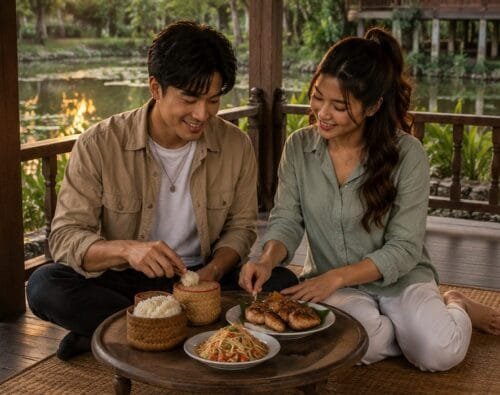
In Isaan, the most popular papaya salad is Som Tam Lao..
The Culture of Food in Sakon Nakhon
T
he journey ends at the table: Let's eat steak at Phon Yang Kham (โพนยางคำ)... Let's gin som tam (กินส้มตำ) by the pond.
Phon Yang Kham is known nationally for premium Thai-French beef, produced through a local cattle cooperative established in 1980 and valued for its marbling.
The Michelin Guide names it a signature product of the province, and Thailand's official tourism directory calls the cooperative a leading national beef producer. Even sold across the country, its identity stays tied to the Sakon Nakhon village it's named for.
Then, deliberately, a contrast: gin som tam — eat som tam, the pounded green papaya salad at the center of everyday Isaan food.
One line points to something the province has gained national culinary prestige for; the next returns to what's ordinary and communal. And the setting seals it — not a restaurant, but "by the pond": food, water, open air, company.
After an ancient sanctuary, a revered monk, a great lake, a national park, and a famous festival, the song's last image before the final chorus is just people eating together by the water.
Why the Chorus Feels Like Coming Home
T
he chorus never claims Sakon Nakhon is luxurious or famous. It says khit theung jang, cheewit chao-baan — "I miss it so much, the life of ordinary country people."
Chao-baan is warmer and more immediate than "rural" — it points to everyday community life organized around family, fields, food, temples, and season. The next line, rak Isaan, thung-na suay-ngam ("I love Isaan, its beautiful rice fields"), widens the frame.
Sakon Nakhon is the specific home; Isaan is the larger cultural landscape it belongs to. The rice fields aren't scenery — they're shorthand for the agricultural rhythm underneath village life: planting, rain, labor, harvest.
So the chorus moves through three scales at once — the province, the everyday life within it, and the region it's part of — and every repetition folds them back together.
However far the verses travel, the chorus lands in the same place: almost home.
A Foreigner's Song, Written from the Inside
A
ny song about Isaan written by a foreigner invites an obvious question: is this place being seen from the outside?
The details answer it. An outsider's song might stay with the province's headline attractions. This one includes a local swimming hole, a seasonal mushroom hunt, som tam eaten beside a pond, and merit-making with one's own parents — activities, not sights.
Ajarn David's earlier books, including Poems from Sakon Nakhon, Under the Weeping Fig, and the language-and-culture guide Why Thailand, clearly demonstrate that he has spent years working through Thai language, Buddhism, and the emotional texture of Isaan life.
"Rak Sakon Nakhon" extends that into music. As with his other Thai-English love songs, he wrote the lyrics and melody first and used AI-assisted tools to help shape the final recording — the technology shaped production, not perspective. That came from two decades of actually living there.
A Thai Love Song for Sakon Nakhon
R
ak Sakon Nakhon isn't a romantic love song in the conventional sense, but it borrows the form of one: two voices, repeated invitations, longing, a chorus built around rak, "love."
The beloved just happens to be a place rather than a person. That's why the nirat framing fits so well, and why the duet structure isn't incidental.
Home, in this song, is never a private discovery — it's made through voices answering each other, through parents and adult children making merit side by side, through communities that keep a craft or a festival alive, through one person saying let's go and another choosing where.
By the final chorus, glai theung baan — almost home — means more than nearing Sakon Nakhon. It means returning to where you belong.